

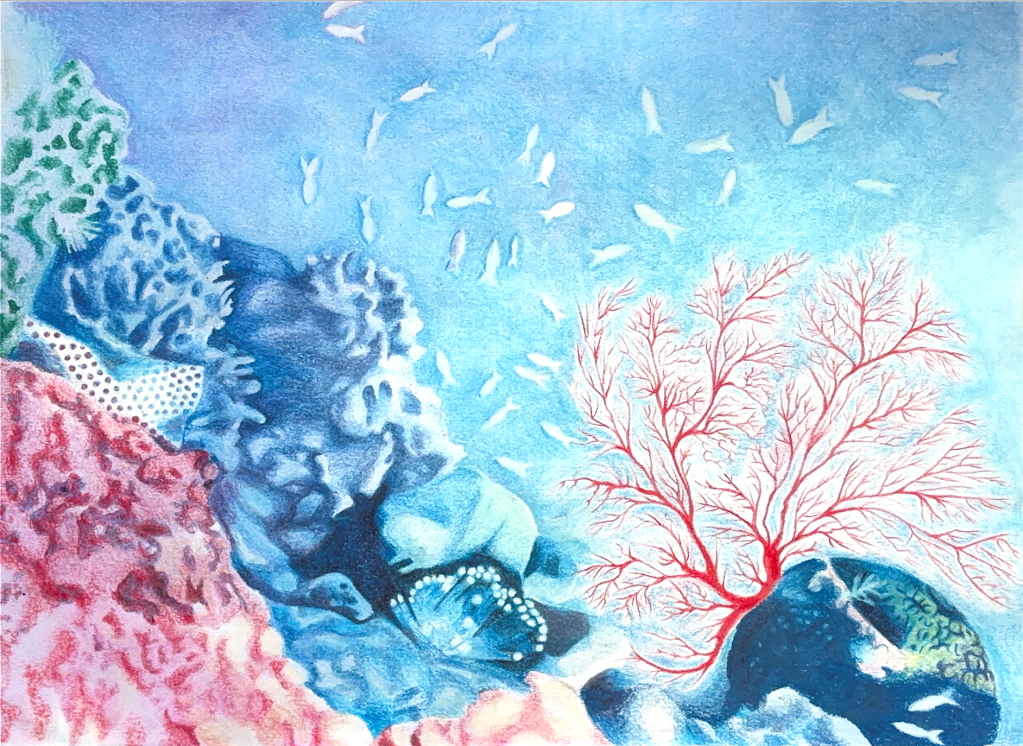
Words by Ellie Thorson, Art by Zoë Graham.
Though hidden from the human eye, cellular technology seemingly powers nearly every aspect of our everyday life. From merely providing internet services, connectivity now powers complex infrastructures and continues to generate new smart services and solutions to everyday and global demands.
Cellular networks strive to develop and implement the most advanced technology; mostcurrent is the fifth generation of cellular technology, more commonly known as 5G. Its download rates can exceed 10 gigabit per second; for comparison, that is 100 times faster than its predecessor, 4G. Through higher radio frequencies of 30 GHz or more, 5G networks are able to accomplish what 4G networks cannot. With 5G subscriptions expecting to reach 4.4 billion by the end of 2027 and an ever-increasing demand for technological solutions to the climate crisis, it urges the question of what opportunities and risks 5G holds in the fight for a brighter, more sustainable future.
While 5G networks may be more energy-efficient in operation, the deployment of its infrastructure, which includes small cells and base stations, call for a 160% increase in power requirements, posing serious environmental impacts. Additionally, 5G’s ability to handle more complex tasks and larger traffic loads can cause greater energy consumption. However, many are supporting the notion that 5G may be an opportunity for the companies behind these technologies to drive and support a seamless global transition to clean power. For instance, tech companies, Nokia and Elisa, utilize wasted energy from Elisa’s networks to heat buildings and water via a liquid cooling station. In doing so, Elisa has reduced its energy use of its 5G networks by 30% and total CO₂ emissions by 80%.
5G has created a platform for sustainable services that can be mobilized in the achievement of the Sustainable Development Goals (SDGs). 5G offers palpable solutions to pressing global climate change issues and humanitarian causes, not just because of its connectivity efficiency, but more so in what it will enable in partnerships in various sectors, such as transportation and agriculture.
With the development of smart farms, 5G can help target SDG2: Zero Hunger, and SDG12: Responsible Consumption and Production. Sensors and monitoring devices paired with 5G can enable farmers to remotely monitor and control their water usage and other numerous, such as humidity, temperature, soil moisture and crop health, thereby ensuring maximum crop yield and efficiency. 5G is advancing food distribution through smart transportation systems to connected retail systems, further reducing food waste while also improving accessibility. Moreover, 5G technologies will reach social causes, such as accessibility to healthcare and educational opportunities.
While 5G’s flourishing role in sustainability cannot be denied, the effects and limitations of electromagnetic frequencies (EMF) cannot be ignored. Firstly, numerous studies have demonstrated the dangerous impacts of shorter wavelengths associated with high frequency networks on wildlife, particularly for birds and insects. A 2018 study showed that insects absorbed these higher frequency powers at an increased rate of 370%, posing a heating effect. In honey bees, this exposure weakened colony strength and egg laying rate of the queen bee. While there is still little research to support 5G health impacts on humans, there certainly are notions for concern going forward. Moreover, 5G connection is mitigated by tree obsuruction; there has already been felling of thousands of healthy, mature trees, directly combating one of our greatest natural solutions to the climate crisis. Thus, it is evident that EMF radiation and 5G installation poses a real threat to biodiversity, natural climate solutions, and potentially even our own health.
As 5G’s expansion continues to grow, its impactful role in a sustainable future is indisputable. Nevertheless, its negative impacts on the environment must not be ignored. While embracing these innovations, we must also see these advancements as a reminder of the natural solutions that exist all around us.
Sources:
https://www.tcl.com/global/en/blog/your-next-smart-phone-5g-vs-4g-what-is-the-difference#:~:text=Speed-,Theoretically%20speaking%2C%205G%20will%20be%20much%20faster%20than%204G.,for%20an%20increasingly%20connected%20society.
https://stlpartners.com/articles/sustainability/5g-and-sustainability/
https://www.nature.com/articles/s41598-018-22271-3
https://www.who.int/news-room/questions-and-answers/item/radiation-electromagnetic-fields



 UnEarth Magazine.
Leave a comment