

Words by Clarissa Bell, Art by Zoë Graham.
I cannot emphasise enough the mortifyingly large self-restraint it has taken to not talk about my love for political and satirical comics once over what is now two, going on three, years of writing for Unearth. I usually orient my once-a-semester soapbox topics to technology – not a satirical comic in sight! Go back and check if you so wish – nothing, nada! Until now, after I spent a summer reviewing some old student magazines. So, here is my bet with you, reader, because you are my protagonist today: this article will talk about climate in the media, and I will try my best to make it the least gloomy media depiction of climate and environmental change you have seen this week – because something about this dynamic has to change. However, in return, I may finally get to talk of the wonderful wit, and importance, of satirical comics in all my mess of headlines, hooks, and hope. Do we have a deal?
Well, I was brought back to St Andrews by an internship and somehow found myself in a storeroom on a humid August afternoon lugging down a bag of decades old student magazines from the seventies to early nineties. I would read them, incredibly diligently – and behold, the comical drawings were interspersed by the time I hit the eighties. Comics aside, I found myself taken aback by how cautiously optimistic students and staff from the seventies, eighties, and even early nineties were, when talking about climate change and environmental research. Cautious, because they still seemed fairly critical of what they thought needed to occur within academia and its image within the public eye for change, the socio-political responsibilities of government towards housing, and UN conventions, – you get the drift, if there wasn’t a deadline or a word limit on this article I could, and would, go on. They are obviously academically minded, yes, but there seemed to be the need to keep the jokes up alongside the seriousness. Talk of socio-political and economic policies, homelessness, educational reforms and important political conferences was put alongside accounts from field trips, reviews for social events, individual rants, and the occasional interdepartmental agony aunt.
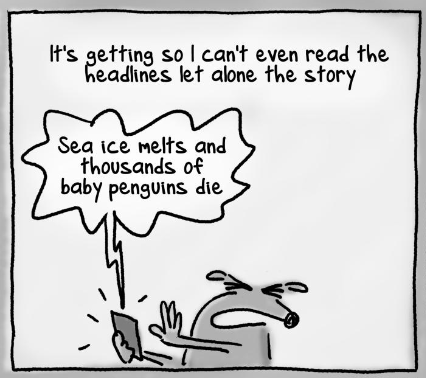
During my work over the summer, as I was reviewing these student magazines, I saw a comic by ‘First Dog on the Moon’ in the Guardian: ‘I only read about climate change now because I have to’. Ashamedly relating with that notion, I read it. Climate change headlines are seldom boring, as we all know by now. My peers in Unearth over previous years have written excellently on eco-anxiety, the need for hope in climate and environment discussions, the need to alter how we talk about climate change to not resort to defeatism. It seems a dangerous notion today to voice exhaustion at such a barrage of headlines telling us what we need to do and how far past it we might be – but then again, I read these sentiments every day both academically and in my spare time. Such a response should hardly be surprising. If I did not have some modicum of hope, I would not be doing what I’m doing, and I assume, neither would most of the authors I talk about. Yet, here I am, secretly feeling my heart drop as I seem to momentarily know and feel… that, and stare, at the final panel in a comic: “I love you but I am sorry I cannot do this for you.”
Notably, other comics by the same author since this are just the types of satirical comics I adore – ‘Young people! It’s not their job to save the world but they are suing Europe anyway’, Australian emu population, and a comic on general bewilderment of the world. Comics and news articles are a way of documenting societal hopes and fears – and we are fearfully hoping for an uncertain future here. Ignorance can’t be bliss; ignorance and media algorithms for news cycles speak to us based on our values, after all.
I am fully aware of the irony of this article criticising the nature of immediate news, fast media outputs making headlines for our attention, among other things, when I am doing the exact same thing! Your attention has been delightful. When we’re talking about our hopes and fears for the future on climate change, some sort of action, needs to happen in the next generation or media cycle. Cautiously hopeful – but throughout all this time and talk of the same issue, you, reader, and I, and authors of all these papers and articles, seem to want this to work out in some small way the same. Hook, line, and sinker, we might be a bit alike in this modicum of hope.
We cannot sustain a democratic conversation about climate change and environmental sustainability in a hypothetical future if we do not find more sustainable ways to engage with news and scientific updates about it. This will mean utilising more ways of engaging with this information – not just more education and floods of information to make a decision. We need to encourage engagement in ways that will keep the conversation going, that do not only appeal to our hopes and fears but vocalise them in turn. We need to use more art and humour, however sharp and sardonic, and to satire those who have a seat at the table, so our voice is heard. Perhaps that’s why I adore comics; however close they seemed to dance around the obvious issue, they always find the edge to get people scoffing, or chuckling at least.
I ended my last article by stating that now is as good a time as any to rethink approaches; here is no different. We have one big opportunity to experiment with media’s role in the sustainability movement, one that history will have a judgement on. This dynamic has to change to have a chance.
I will try to do this for you, at least for the rest of my time here.


 UnEarth Magazine.
Leave a comment