
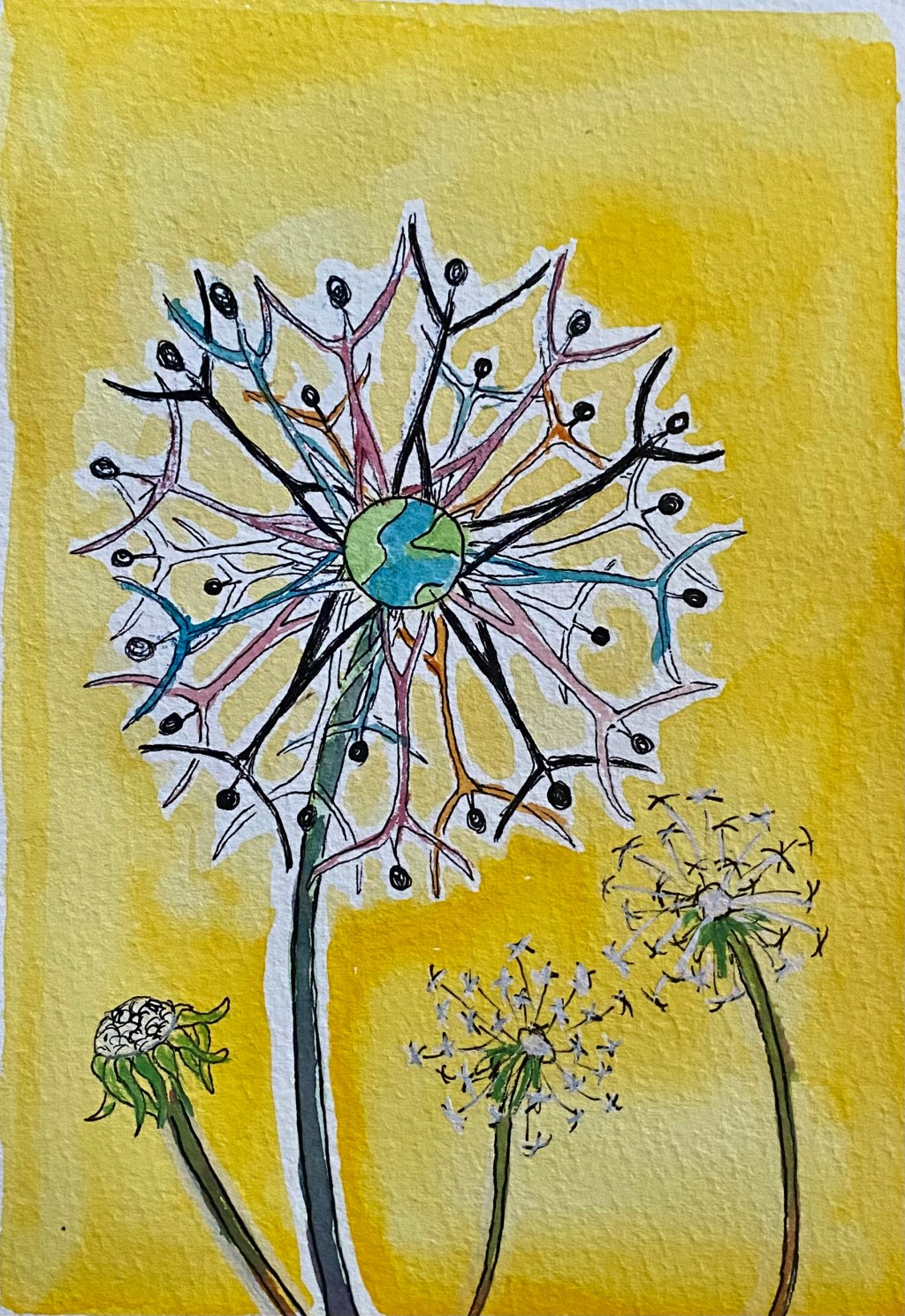
Words by Lucie Martikan, Art by Leela Stoede.

Imitation is the sincerest form of flattery, but could it also save the world? In the case of biomimicry – many think so, but I’m hesitant to agree.
Biomimicry in its simplest terms is the imitation of earth’s nature to solve human problems. Particularly, the incorporation of the structural characteristics or natural function of a plant, animal, earth process, or natural resource into a human invention or innovation.
A popular anecdote to explain biomimetics details a hunting excursion, during which a man called George de Mestral noticed the many burrs which clung to his clothing. He noted their ability to attach and detach to objects with ease, and a look under his microscope revealed minute hooks whose primary function was to cling. Mestral later went on to invent Velcro – largely inspired by and fundamentally imitating the tiny hooks on burdock burrs.
Returning to human problems: what greater human problem is there currently than climate change? Nature-inspired solutions and biomimetics are increasingly globally recognized as a climate action innovation strategy – with fascinating results.
Structure and function
Biomimicry innovations can generally be separated into two forms: imitating either a natural structure or function.
A classic example of structural imitation is the Eastgate shopping mall in Harare, Zimbabwe – modeled after a termite mound. The natural ventilation structure of a termite mound, mediated by a chimney structure at the top of the mound and tunnels below, draws cool air in and warm air out. Biomimetics in this case drastically increased energy efficiency by creating a natural cooling system that does not require natural gas, or even electricity.
Increasingly effective solar panels are being developed due to nature-inspired design. One for example replicates the veins of a leaf and – due to its hybrid capacity to harness solar energy – generates 10% more electricity, and captures clean water vapor at the same time.
The creation of LED lights was inspired by the highly efficient function of the bioluminescence of fireflies – and uses 75% less energy than conventional bulbs.
There are wind turbines structurally modeled after bird feathers, and industrial land remediation strategies functioning through the use of fungi. The examples are endless. Creativity is boundless.
Importantly, aside from the clear technological benefits, biomimicry makes room for creative expression in climate mitigation strategies, and offers ways to reinforce human connection to our environment and appreciation of the natural world. Could this be a paradigm shift to something simpler? A more natural way of doing things and a return to Earth’s most fundamental processes, and a progression to a more nature-centric society?
The big questions
Here’s why I hesitate to agree.
A question that should be asked in relation to green technologies, particularly energy generation, is: what are they for? Solar energy – even highly efficient solar panels modeled after vibrant butterfly wings and self-cleaning desert beetles – is to power something. However indirectly, energy generation is still used to contribute to industrial expansion and growth.
Does it matter? Perhaps on the smaller scale, not so much: energy efficiency is undoubtedly a climacteric mitigation strategy and has proven to lower greenhouse gas emissions caused by our built environment.
But is biomimicry the key to restoring earth’s natural equilibrium, combat climate change, and repair our connection to our environment? Or is it just a tool to further human industrial revolution, and, inevitably, destruction, for the sake of human growth?
In his book titled “Planetary Improvement,” centered around green technological innovation, Jesse Goldstein asks: if we want to conserve nature and save the planet, whose world are we aiming to sustain? Does nature have autonomy;
I am certainly not immune to being swept away and wowed by innovative and creative climate technologies – and as a nature fanatic and Sustainable Development student I too envision a future where the power of human innovation can reverse – or at the very least combat – the anthropogenic tragedy that is climate change. But I can’t help but raise the question, while creativity inspired by nature is a beautiful thing, are we truly returning to nature’s solutions, or are we twisting them and using them to further our economic growth and industrial agenda?
Is it truly a nature-centric solution? Or a tool to sustain human development and destruction as long as possible?
Is it that deep? Perhaps not, but it’s something to consider.
Back to basics
It’s an interesting notion, the idea of synthetic replication of our earth’s natural processes. Perhaps it is our global responsibility, as a species that has historically suppressed, controlled, and systematically un-wilded our world, to now return to its most basic design to right these wrongs.
I’d like to imagine that the power dynamic has indeed shifted, and the abominable man now kneels, knees in the soil, asking the earth for guidance.
But I do not think that biomimicry alone represents this shift.
A true return to nature’s design requires a complete reevaluation of today’s society, and asks not how we can grow more efficiently, but why we should. In this case, biomimicry by design could be one part of an economy that’s more focused on sustainability, rather than just a more efficient way to squeeze energy from limited resources so we can go on living the way we always have.
Does biomimicry represent a paradigm shift? I don’t think so. Is it a start? Absolutely.



 UnEarth Magazine.
Leave a comment