

Words by Lydia Allan, Art by Lucy Brown.
Introduction
In the shadow of my mother’s caffeine-supplemented attempts at escapism, I spent hours of my childhood hopping between Lancaster’s various coffee shops. But it was only after beginning work as a barista in a small independent café that new dimensions of the coffee world were revealed to me. The array of biological, geographical, and social processes which collectively allow cup after cup of coffee to manifest at the hands of the machine are inherently complex and therefore to me endlessly fascinating. It is this incrementally-constructed knowledge base that allows me to make the most informed choices regarding taste and sustainability; the piece below is a subjective articulation of what I prioritise to make the most of my cup.
Geography
The taste of a cup of coffee is influenced by a myriad of variables – roasting, grinding, brewing – however the fundamental flavour profile is first dictated by the region of growth. Coffee is predominantly grown within a longitudinal window known as the Bean Belt (Figure 1), situated between the tropics, and flavours can be roughly grouped continentally.
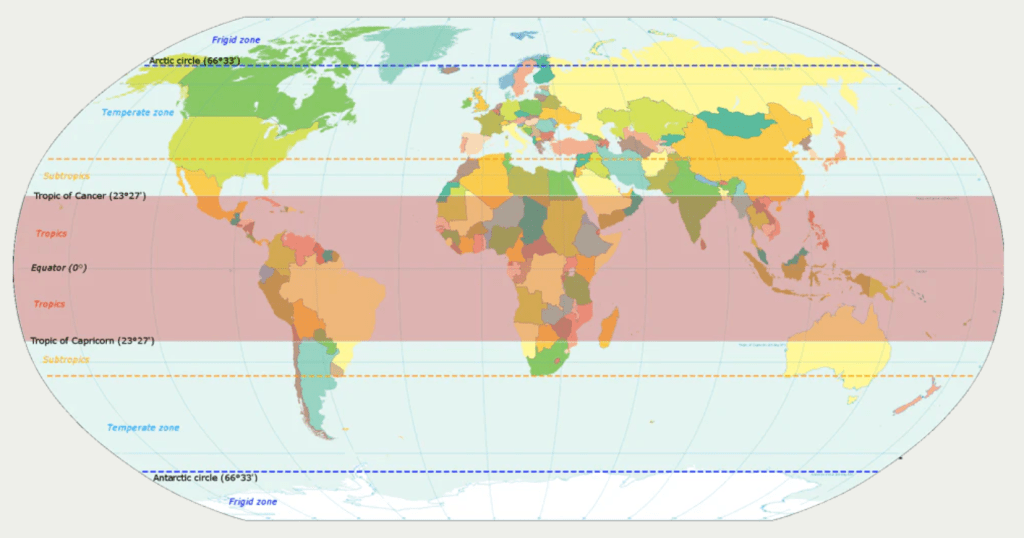
Figure 1: The Bean Belt
Chocolatey coffees are typically grown in South America, and floral and fruity coffees in Africa, however this is a gross generalisation and microclimates or edaphic conditions can manifest variations on a national or even local scale. So, how is this geography useful? Well, my general barista rule would be that chocolatey/nutty coffees make the best milk-based drinks, whilst fruity and floral options make the most exciting cold and batch brews. Another overarching rule: Robusta beans are cheaper, easier to grow and have a higher caffeine content, but Arabica beans are almost always better tasting. When choosing beans, I consider growing region and associated notes to identify a flavour profile I will enjoy more, whilst being unafraid of trying something new.
Obtaining Coffee
Zooming in from the global to the individual, the next consideration is location – do I home brew or visit the coffee shop? I am in favour of any experience that provides more than just a hit of caffeine, and therefore my advice would be to always opt first and foremost for where most enjoyment lies.
We are fortunately in a position where the taste of a cup of coffee does not have to be sacrificed in the name of sustainability, and often those with sustainability in mind have an even better handle on the tasting experience of your cup. That being said, I would still advocate for making individual choices which consider the global – aiming for transparency and opting for single origin coffees with a clear supply chain where possible. Any business aware of the fragility of the coffee industry in the hands of climate change should make their concern evident through their packaging – if buying beans or relying on a take-out cup, I use compostability and recyclability as good intel into a business’ priorities.
Further, whilst carefully planned café interior design may demonstrate commitment of a business to the entire customer experience, I remain equally wary of what I will subjectively term the café equivalent of ‘greenwashing’, in which a sleek and stylish display may mask attempts to bypass focus on brewing good-tasting, sustainable coffee.
Moving away from the café to home brewing can bring quality control back into my own hands. I can choose beans with flavour profiles I enjoy, and use equipment which best suits my needs. I use an AeroPress or Chemex to obtain filter coffee, a Mokapot for intense and espresso-like drinks, whilst a Cafetiere is arguably the most accessible way to make sharing quantities of black coffee. There is something satisfying about incrementally adjusting brewing techniques to reach your idea of perfection just before the end of the bag. I would always opt for buying whole beans ground in-shop over pre-ground coffee, as coarseness needs to be adjusted to suit equipment and over time aeration impacts the coffee’s flavour.
Concluding remarks
Looking outwards to you, reader, here is a summary of my advice from 4 years of experience in the barista world:
1. Choose coffees grown in regions which provide the taste profile you enjoy most.
2. Whether you consume in cafés or at home, opt for single-origin coffees which value growers and consider sustainability even if only implicitly such as through packaging.
3. If unsure about what to choose – ask! Independent coffee shops are run by people who care about consumer experience – maximising your satisfaction is key to keeping their business running, and often there is a wealth of underutilised knowledge under the baristas’ belts.
4. Promote your choices as you learn – the coffee world is vibrant and exciting, but its longevity is reliant on us making sensible and sustainable choices in the face of climatic and ecological change and sharing these choices with others.



 UnEarth Magazine.
Leave a comment