Words by Mia Cammarota, Art by Leela Stoede.
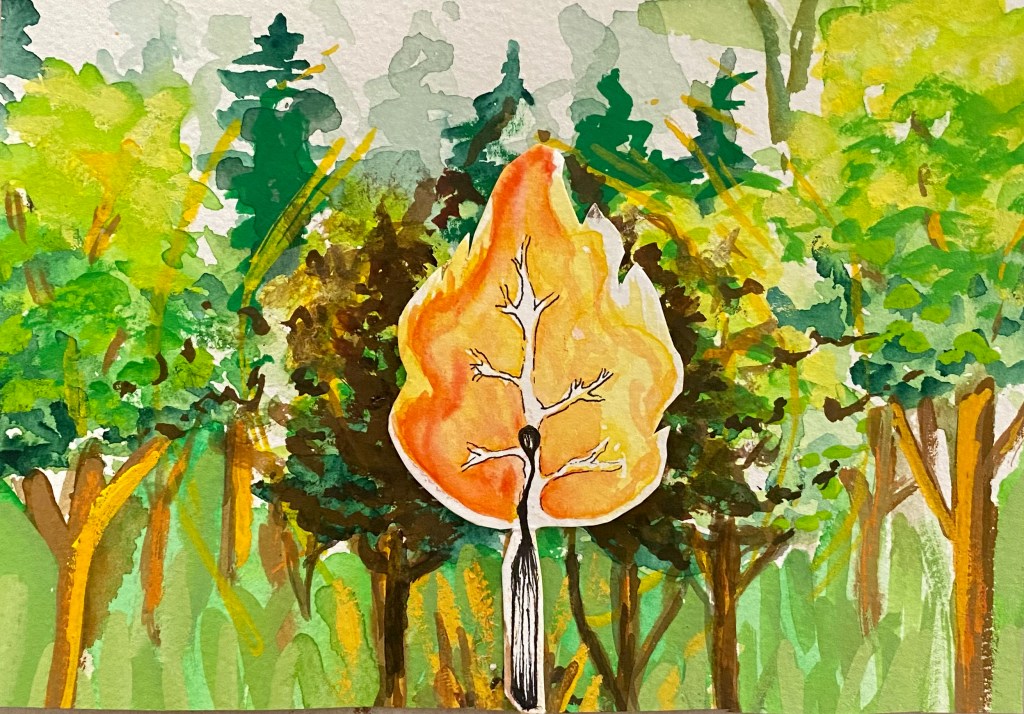
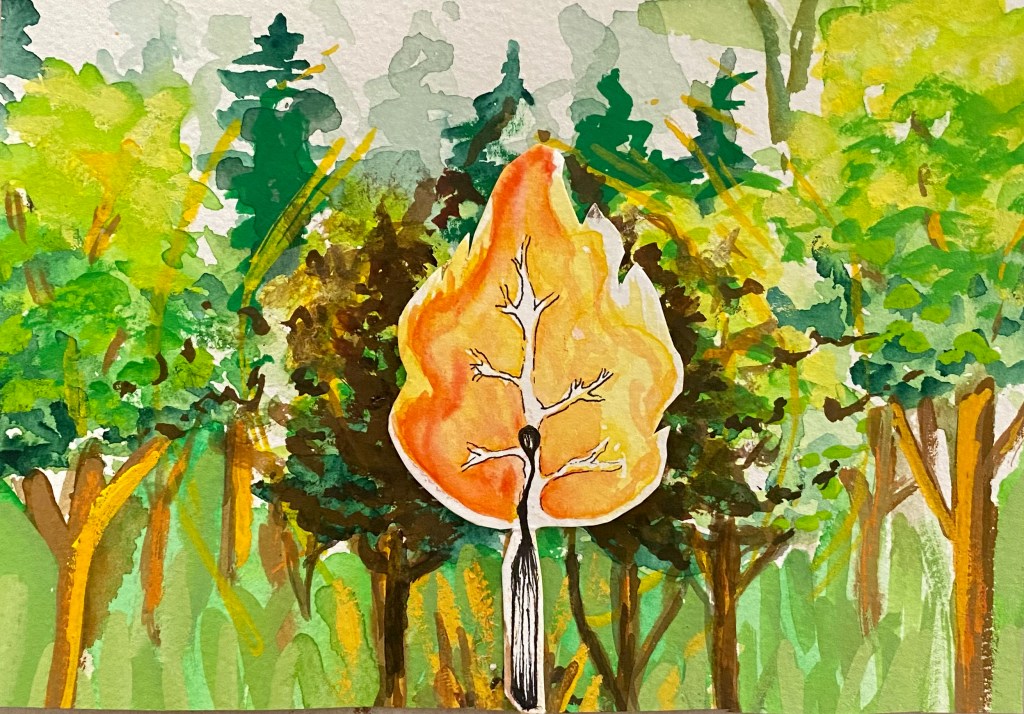
Wildfires are often misconstrued as solely man-made disasters, dismissing any links they may have to the climate and environment. 2023, a year in which people have faced the extreme effects of wildfires like never before, has put this idea into question. The most notable wildfires were those in Canada, Hawaii, Greece, Australia, and Russia, but these are only a handful which were reported worldwide. The relationship between these disasters and climate change are closely linked; maybe if society starts realizing the effects of climate change are all-encompassing, then local, national, and global communities can start creating the action and attention these fires need.
August usually experiences the most severe fires due to its especially hot and dry weather, causing natural organic material to become drier and increasing the potential of catching fire. Temperature, soil moisture, and the presence of trees and shrubs are all factors that increase the risk of wildfires. While these fires can be linked to man-made causes such as, unattended campfires, burning debris, and discarded cigarettes, climate-change induced global droughts and dry climates are increasing the speed and intensity at which wildfires spread. This is especially the case for this season of fires.
In North America, especially in the West, the dehydrated climate is the perfect fuel for the growth of dangerous wildfires. The number of wildfires has doubled between 1984 and 2015, and 2023 is carrying this trajectory. Further, in North America, wildfires commonly spread in Canadian boreal forests. In late June, these fires broke the record for smoke emissions released in one year. The entire continent felt the effects of poor air quality which immensely affected Canada but also reached the east coast of the U.S. According to the Copernicus Atmosphere Monitoring Service dataset, “The total wildfire emissions for 2023 is estimated to be almost 410 megatons.” 2023 also witnessed the extent and devastation of wildfires in seemingly unexpected locations, like Hawaii. However, what Hawaii experienced was a perfect storm of climate-induced conditions, including severe drought and Hurricane Dora, which created a low-pressure storm with high pressure in the north that made winds that fueled destruction. Officials have reported that at least 97 people died in the Hawaiian wildfire along with an estimated $6 billion in economic loss. The wildfires across North America were hopefully a wake-up call for many, as they spread smoke across borders and caused devasting destruction and death in Hawaii.
Beyond North America, the grave capacity for destruction by wildfires is worldwide. Parts of Europe have also been dramatically affected, with the EU breaking the record in 2023 for its largest wildfire ever recorded to date. Protected areas were significantly affected, as 41%, 192,851 hectares of the EU biodiversity reservoir of Natura 2000 were burned. Portugal, Spain, Italy, and Greece were significant points of the disasters. Again, it should be noted that climate change is playing a key role in causing hot, dry climates, which greatly increase the risk for these fires to spread. Australia, known for its susceptibility to wildfires, has been urged to prepare itself for more wildfire due to their “above-average temperatures, decreased rainfall, high fuel loads, and changing weather patterns,” according to the Australian Fire Authorities Council.
The year 2023 is coming to an end and communities affected by wildfires have done some reflecting on the relationship between climate change and wildfires. The intensity of this year’s wildfire season has been devastating but has struck some action amongst local, national, and global groups. In Hawaii, revisions are being made to their climate change adaptation tactics which can also protect them from future fires. This includes not leaving areas of land covered in flammable grasses, adopting more wildfire-resistant buildings, and shutting down less dams so the island can store more water. In Canada, the mind-set has shifted from putting out flames to making fundamental changes to prevent the start and spread of the fires. Some ideas are, closing forests to people when they are most flammable or when extremely hot, dry, and windy conditions are present, a tactic Australia also has implemented. The EU, has promoted practices such as reduction vegetation, spacing trees properly, and monitoring ‘prescribed’ burning to help reduce the intensity of fires. With the education of the public on the relationship between wildfires and climate change, greater action can grow within communities at all levels.



 UnEarth Magazine.
Leave a comment