
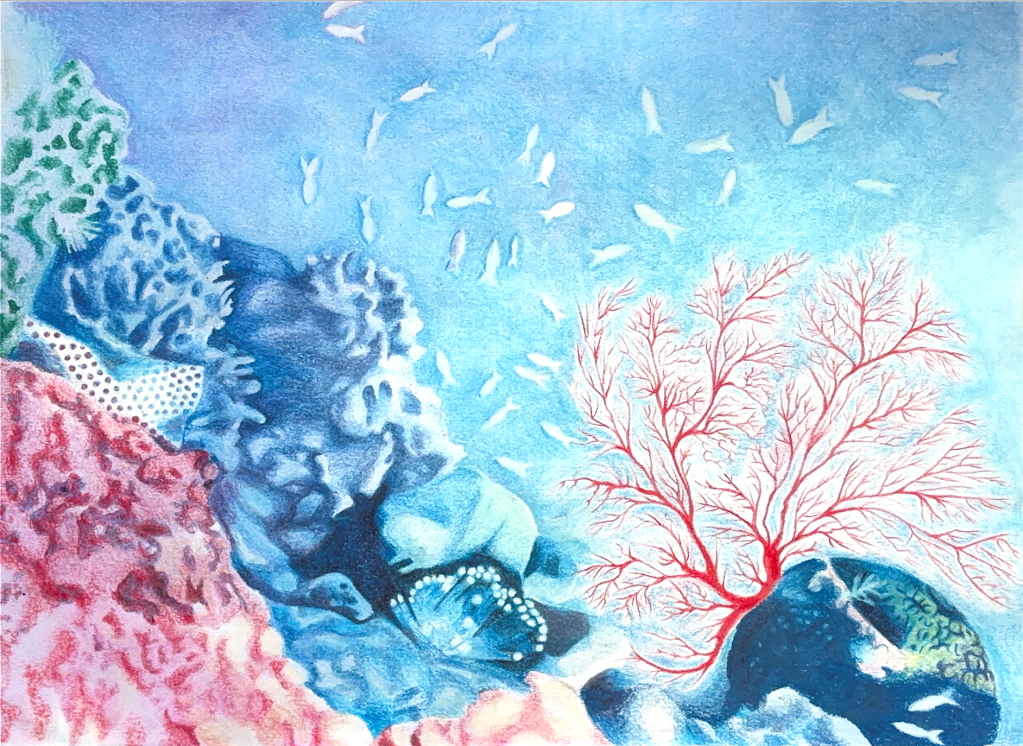
Words by Janvi Poddar, Art by Emma Dalton.
I am a 3rd year Economics and (human) Geography student passionate about climate justice. In my formal and informal education, I have prioritized the critical evaluation of the role of colonization and capitalism in the climate crisis, and in meeting sustainability goals. The following article sheds light on my own perspectives, as well as views shared in interviews with experts from the university.
The 21st century’s environmental, social, and cultural wars can largely be seen as a legacy of colonial exploitation and oppression. For instance, the poorest 50% of the global population own a mere 2% of net wealth. It is a known fact that climate change has extremely unequal impacts and will continue to exacerbate existing inequalities, with the poorest, most marginalized groups in the Global South being the most vulnerable to environmental catastrophes.
At the crux of the climate crisis, global inequality, and injustice are the problematic Eurocentric ideologies that emerged during the Enlightenment and the Industrial Revolution, which are now embedded in the socioeconomic and political fabric of the modern world.“Coloniality is entrenched in the world we live in and the problems we face… especially when you consider the origins of [environmental] crises,” Dr Ariadne Collins, (School of IR) suggested.
The systems that caused these problems cannot be entrusted with addressing them. The first step, therefore, is exploring other avenues of thinking, knowing, and acting. The only logical starting point, then, would be to decolonise knowledge.
The debate around decolonizing knowledge (or anything else) is a complex and highly polarizing one. Decolonizing knowledge, and therefore curriculum, would mean reevaluating the legitimacy and merits of many dominant Eurocentric ideas, the most controversial of which would be the capitalist system.
Questioning the status quo is never easy. Prof. Dan Clayton (Head of SGSD (School of Geography and Sustainable Development)) emphasizes that those against decolonial thought have termed it a “woke enterprise”. In my opinion, these are the same people who believe that we have achieved racial and gender equality. I have come to believe that we have no chance of addressing the climate crisis or achieving goals of ‘sustainable development’ without giving due consideration to decoloniality.
Prof. Clayton pointed out that it is vital to consider sustainability in every school and department. He spoke of the St Andrews Centre for Critical Sustainability (STACCS), one of the many research and educational resources at our disposal. STACCs and other projects at the university have extensively been involved in considering decoloniality in sustainability and climate discourse. SGSD, among a select few other schools, have made massive strides in making their curriculums more inclusive and reflective. But most Schools have failed to consider widening their knowledge frameworks to fit the needs of the 21st century.
The School of Economics, for instance, has mostly outdated curricula and reading lists when it comes to sustainability and decoloniality, given the relevance of economics education in addressing global challenges. By introducing a more comprehensive spectrum of authors, thinkers, and practitioners, students can better appreciate the global tapestry of ideas and approaches to sustainability. This inclusivity not only empowers those historically underrepresented but also equips students to engage with the world’s complexity more effectively.
The urgency of decolonizing the curriculum becomes ever more evident in this regard. We need to critically evaluate questions of class, gender, race, and human-environment relationships, in order to collectively advocate for radical change.
“If we only think through the dominant framework of addressing environmental crises, we risk missing out on a whole lot of alternative approaches that have existed for centuries, and we also risk replicating the harmful strategies that [led us here],” Dr Collins added.
A decolonized curriculum fosters critical thinking by encouraging students to question the status quo, challenge established norms, and think beyond the boundaries of traditional Western thought. It provides them with the tools to analyse problems from multiple angles, ultimately leading to more innovative and effective solutions. In an age where adaptability and resourcefulness are paramount, such skills are indispensable.
Indigenous knowledge systems, often marginalized in traditional curricula and debate, have much to offer in creating a more sustainable, less exploitative world. These communities have stewarded their lands for generations, holding valuable insights into sustainable agriculture, conservation, and resource management. Through an integration of indigenous perspectives rights historical wrongs and providing invaluable tools for sustainability.
To decolonize knowledge, we must acknowledge the inherent biases and historical legacies embedded within it. Decolonizing involves rethinking and reimagining ideas of equality, justice, and merit. It also involves revaluating socioeconomic concepts such as welfare and growth, and the role they play in our wellbeing.
University education often focuses too heavily on producing competitive individuals who can live up to the traditional norms of success, and in the process conform to the status quo. Dr Matthew Sothern (Director of teaching for SGSD) believes that this conformism “further entrenches a cosmopolitan privilege” that blinds us.
I fear that we will fail future generations and fail the planet simply because we collectively refuse to come to terms with the glaring reality that our current politically economy is colossally flawed. I fear that decoloniality, which is currently merely an afterthought in academic discourse, will be reduced to a buzzword, just another “woke” idea.
I find solace in the fact that there are many in the world, and at this university, who are doing all they can to prevent this. As Prof. Clayton puts it, “resistance is not futile.” If enough of us resist, there may be hope for humanity still.



 UnEarth Magazine.
Leave a comment