
Words and photography by Kerys Bettles, Art by Lucrezia Belpietro.
In May, I walked the West Highland Way, a ninety-six mile journey from the lowlands of Milngavie, just north of Glasgow, through the Highlands, to Fort William, the base of Ben Nevis. I walked alone, wild camping each night and carrying all my camping supplies and food. Each morning, I would wake and walk until I was tired, usually reaching around twenty miles each day, often through mountainous terrain. On the way, I let my body be guided by a sense of slowness; manifest through my mode of movement. I let my thoughts emerge and I worked through them, without the usual harshness and urgency of my regular life, thinking about how the mind is meant to work at 3 miles-per-hour.
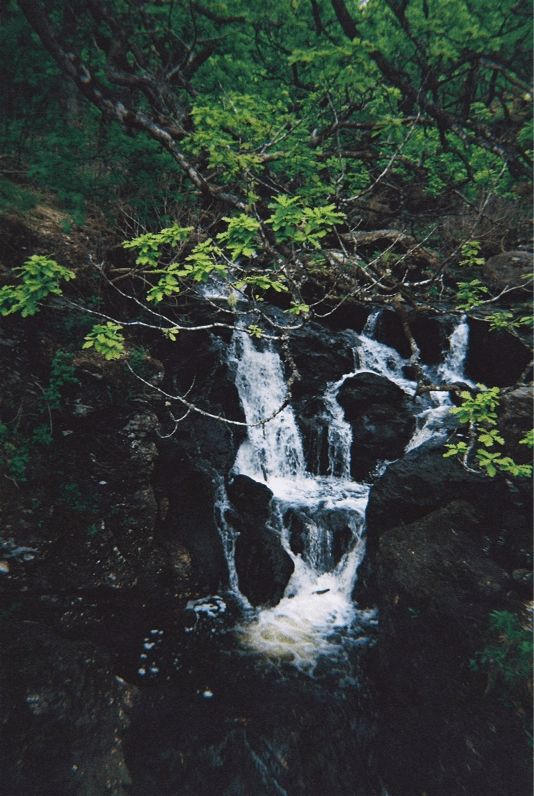
The concept of slowness is often alluded to in anti-capitalist arguments, with calls to resist grind culture and the gradual erosion of our attention span, facilitated by harmful technologies that are designed to be depended on. I took this doctrine to its extreme during my walk, choosing to be guided by a sense of slowness. I also embraced the idea of disconnecting to reconnect, tuning in to the sounds of birds more acutely than I would in the purposeful strides of my everyday life. My sense of time was not structurally dictated, but embodied; my sense of space shaped by the skies. I slept by and swam in the cool waters of Loch Lomond; my relationship with the Loch shifting from awe, to familiarity, and finally to resentment, having stuck by its bonnie banks, roving its rocky and rooted Eastern shore for twenty miles on the second day of the way. On the fourth day, I wild camped in Glen Nevis, pitching my tent as the sun was dipping with richness, diffusing through the valley. It was at this moment that a wild red deer emerged from the nearby woodland, walking with such grace and beauty around me and my tent, wholly unperturbed. It literally took my breath away.
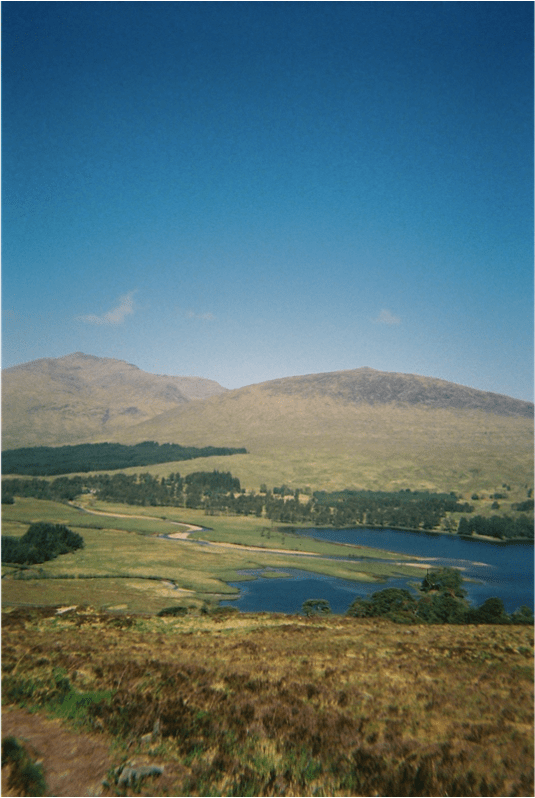
I also enacted a logic of slowness through my decision to document the way with analogue photography. Developing these photographs a couple of weeks afterwards, I enabled my empiric memories to solidify before they could be shaped by their digital counterparts. Further, by writing about my experiences in this way, I am embracing a slow form of discourse, each word carefully chosen and placed, one foot in front of the other, often stopping to look back and reflect. Writing and walking can be understood as reciprocal practices, with a long tradition of literature that blends the two. An involuntary skip, the words cascade onto the page in a narrative flurry, a waterfall up ahead, the words toppling atop of each other, bit by bit, syllable by ebbing syllable. Letters trip upon the next, little by little, as I stumble on a root. Emerging from the woodland, the pace becomes languid and the body opens, the chin lifting to the Scottish sky. The words reflect the way we walk with such transcendence.
With little conversation, the words stick around more, re-emerging at times, forming an assemblage of meaning and memory, like the very rocks we stand upon. I listened to music twice, for motivation, a bit of reggae to ease the muscles and keep the feet treading ahead, to a syncopated beat.
Row fisherman, row
Keep on rowing your boat…
Day, day by day
I man step it along the seashore.
I characterised my experiences in the title of this piece as a tale of slowness and solitude. I have already described how my walk was permeated by a sense of slowness, though in actuality it was quite quick! On the contrary, I was merely alone in material conditions. As well as meeting some wonderful walkers, I was wholly entangled with beings that breathe and grow and move as we do too. Where capitalism can be resisted through slowness and thoughtfulness, it can also be resisted through relationality. Systematic attempts to alienate each of us from ourselves, from the land, and from each other, through processes of abstraction, disconnect and detachment can only be countered with connectedness and care.



 UnEarth Magazine.
Leave a comment