
Words by Amy Manvell, Art by Holly Brown
It’s a Tuesday afternoon. I’ve just popped into Superdrug to buy a new foundation. My previous one ran out a few days ago, so I’ve been leaving the house with less makeup on. Such a timesaver. For years, when running late, I would frequently prioritise covering blemishes and putting on eyeliner over having breakfast. This makes me think: am I really buying this because I want to wear it? What does my purchase mean as a statement about society, or the environment, or my contribution to the capitalist system? Should I buy it at all?
I pick up the bottle. The glass is cool in my hand, vaguely my skin tone, with a blue plastic cap. I wonder what is inside. What are the 50 chemicals on the barely legible ingredients sticker that I am putting on my face (and washing down the sink)?
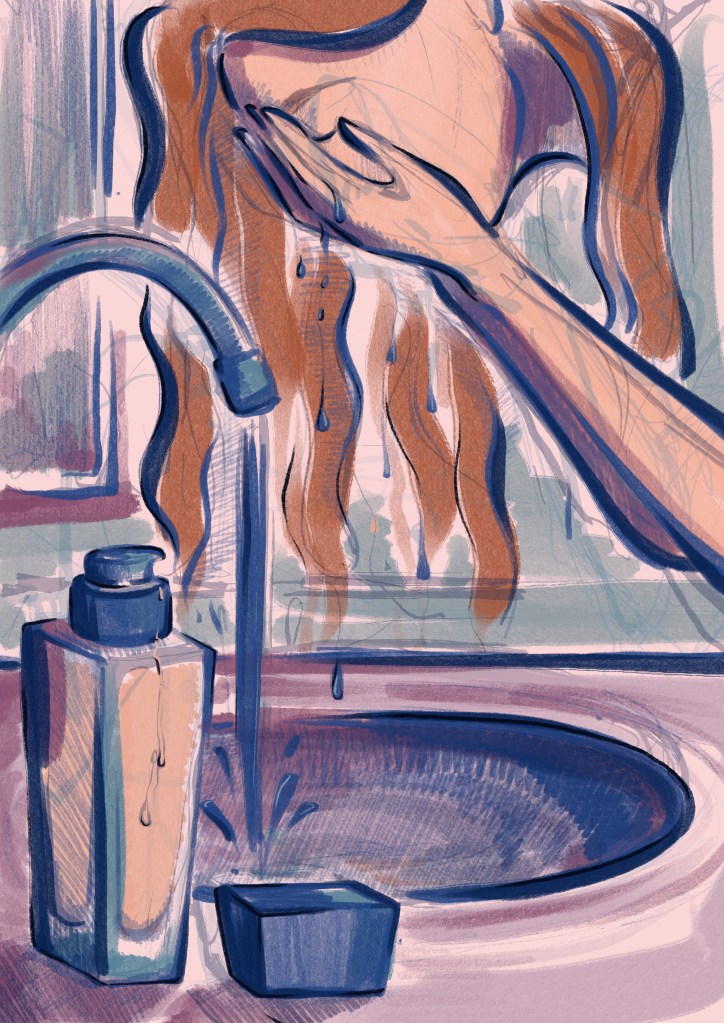
I look into the small mirror, sandwiched between pictures of lustrous mascara models, at my own face. There are a few lines, becoming more visible as I grow. The dark area under my eyes has been more pronounced recently, and the skin around my nose is flaky and dry. Will this foundation fix my features? Why am I trying to fix them?
My mind wanders to the wave of new ‘aesthetics’ with meteoric rises and falls on TikTok and other social media platforms. Clean girl, e-girl, quiet luxury, cottage core, dark academia, strawberry makeup, Pilates princess – one ‘trend’ that seems to pose as a personality shop after the other.
These categories of persona feast on insecurities over conforming, consuming, and cut-and-pasting not only an external look, but the facade of possessing certain characteristics (e.g. a level of fitness, wealth, or intelligence) to other people. So, what does this mean? Does my buying a certain makeup product really make that much difference? What message am I trying to send to the world?
The rapidly decreasing lifetimes of trends are driving people to buy more and abandon more. These trends are marketed as fashion ‘communities’ that are founded almost exclusively from surface-level appearance and affiliate links rather than connection. The desire to retain all this stuff is skin-deep.
Ultimately, only two things change when you make yourself fit in: the shit that you accumulate to fit the category (the makeup, the clothes, the nails, the accessories), and the environmental impacts of extracting, producing, and transporting all these materials to you, for you to throw into landfill. Retail therapy for your self-worth is ineffective and unsustainable. It won’t make you or the planet happy.
Yet… I want to conceal my spots and brighten my tired eyes and define my cheeks. I want to be presentable. I want people to notice that I look effortlessly good. I want the unattainable. This foundation could still be the crutch I need.
I try to remember all the tips from the British Beauty Council sustainable beauty guide, to see if the one I’ve picked up, amongst this chaos, is acceptable. But the future of the product in my hand is still linear. Once I’ve worn it day by day, the container will empty, and I’ll throw it away. Parts of this product are recyclable (the glass bottle), but I know that only 9% of cosmetic packaging is meaningfully recycled out of the 280 million tons produced each year.
Also, if the plastic I can see isn’t bad enough, 9 out of 10 cosmetics and personal care products from the four largest brands in the UK (L’oreal, Procter & Gamble, Unilever, and Nivea) contain microplastics, which are detrimentally impacting marine life, ecology, and human health. So, what I really put on my face and wash down the drain… is plastic.
I shift my gaze to the models in the photos. The ideal reflection. But, I realise, a second later, that they are no more than images. Images that have been carefully constructed and placed to entice me into buying even more.
Is buying this foundation worth it? I will never look like them, but if I buy it, I’ll be in a financially invested attempt to do so. However, I think, the true ‘cost’ of these purchases needs to be measured by more than the confines of my bank account, or my self-esteem.
I am still standing in the shop. I am late for my seminar. Should I take this foundation to the till?



 UnEarth Magazine.
Leave a comment