

Words by Katie Gretter, Art by Zoe Graham
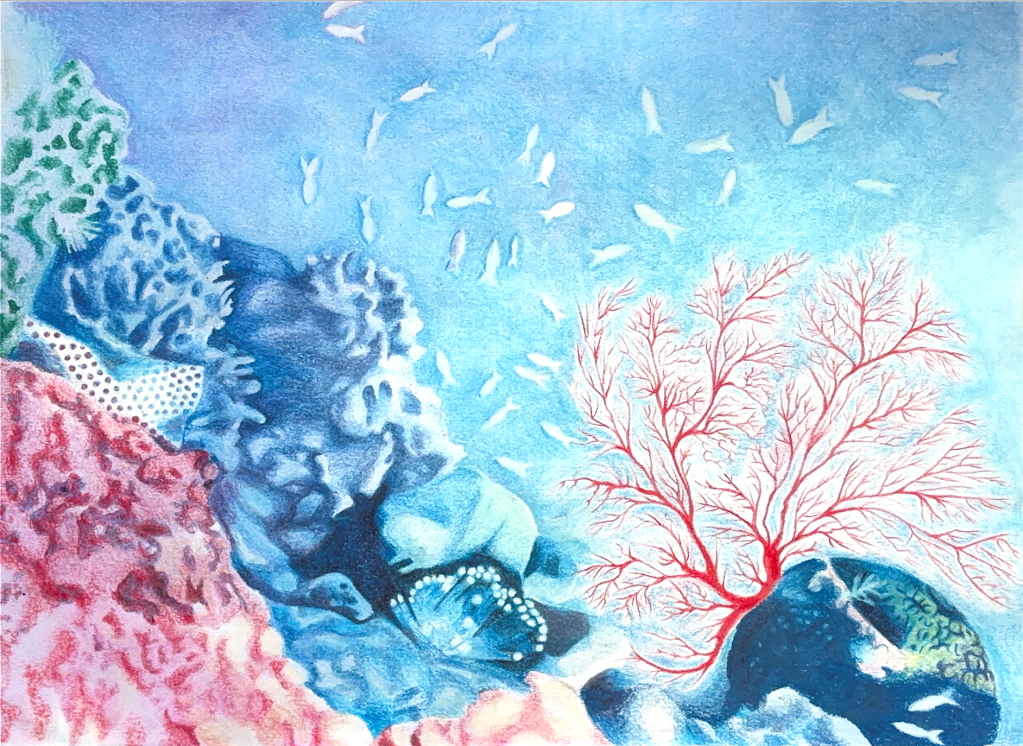
I have experienced nothing quite like scuba diving. I feel completely at peace swimming over purple coral heads as clouds of yellow and black-striped Sergeant Major fish dart by in unison and a brightly colored parrotfish pecks at algae on a rock. I am lucky to have experienced this beautiful world below the water. Unfortunately, over 8 years of diving, I’ve also witnessed the high level of destruction humans have committed against the ocean. From seeing a collapsed reef in Grand Cayman that had been hit by a cruise ship, to plastic pollution in clouds so thick it was hard to swim through off the coast of Bonaire, to a dive ended abruptly when we realized a ship had dumped sewage over the reef in Roatan, a highly illegal but all-too-common- occurrence.
An increasing body of studies have shown the environmental damage that cruise ships inflict: they emit major air, water, and land pollution, risking human and habitat health (Lloret, et al. (2021)). So, when Royal Caribbean announced its newest and largest ship ever, Icon of the Seas, which set sail from Miami at the end of January of this year, I was a bit more cynical about its seven pools, indoor waterfall, ice-skating rink, and 20 decks.
Already, I’m not the only one to feel opposed to the ship. It has received pushback, perhaps most significantly for its use of liquefied natural gas (LNG), which cruise ships have increasingly been using over the years as a ‘clean fuel alternative.’ Under some estimates, LNG is supposed to cut emissions by 25%, and contain less Sulphur and nitrogen oxide than bunker fuel, the most common cruise fuel choice; bunker fuel has been linked to cardiovascular disease, cancer, birth defects in addition to exacerbating climate change. Unfortunately, for the hope of an energy transition, environmentalists warn that LNG still needs to be monitored as there is the possibility of methane leaking from the fuel emissions, which traps 80 times more heat than CO₂, accelerating the Earth’s warming. Dr. Mark Jacobson, the Director of the Atmospheric/Energy Program at Stanford University does not mince words, saying, “LNG is a dirty fuel.” While many argue that to travel at all brings about pollution, cruise ships emit three times that of airplanes, according to a 2023 study from Transport & Environment.

From a social standpoint, cruises aren’t much better. While visiting Caribbean islands, I’ve talked to many divemasters who grew up on the islands, or have lived there for significant portions of time, to hear their perspectives on the matter. Many talk about the unsustainable model of having thousands of people swarm to the small islands for mere hours (boats stay in port for an average of 8-10 hours) during a day before leaving and moving on to the next island, normally providing no benefit to the night-time economy. From an economic perspective, it doesn’t afford local businesses stable sources of income or benefit the community. In a study conducted on the Greek island of Chios, residents found cruise ships to be a hinderance to their local development as they found them to be a constant distraction from long-term sustainable development based on the needs of the community. Additionally, many cruise ships set up their own ventures on the islands or make deals with local businesses that cut a portion of the income that these businesses are able to earn. Honey (2009) found that while cruise passengers in Costa Rica spent an average of US$55 per day, visitors overall spent 14 times that with an average of US$653 per day.
I’ll leave it up to the reader to make their own conclusions on cruise ships, but as a diver who has seen first-hand the damage they can do, I recommend, at the very least, doing your research and considering how your travel plans can be as sustainable as possible.



 UnEarth Magazine.
Leave a comment