
Words by Lucie Martikan, Art by Iona Maclaren.
Many Millennials and Gen Zs can relate to making fun of their Baby Boomer and Gen X parents for believing everything they see online, falling for fake news posts and scams that their younger, more digitally literate children can quickly identify as fake. I, myself, am definitely guilty of this.
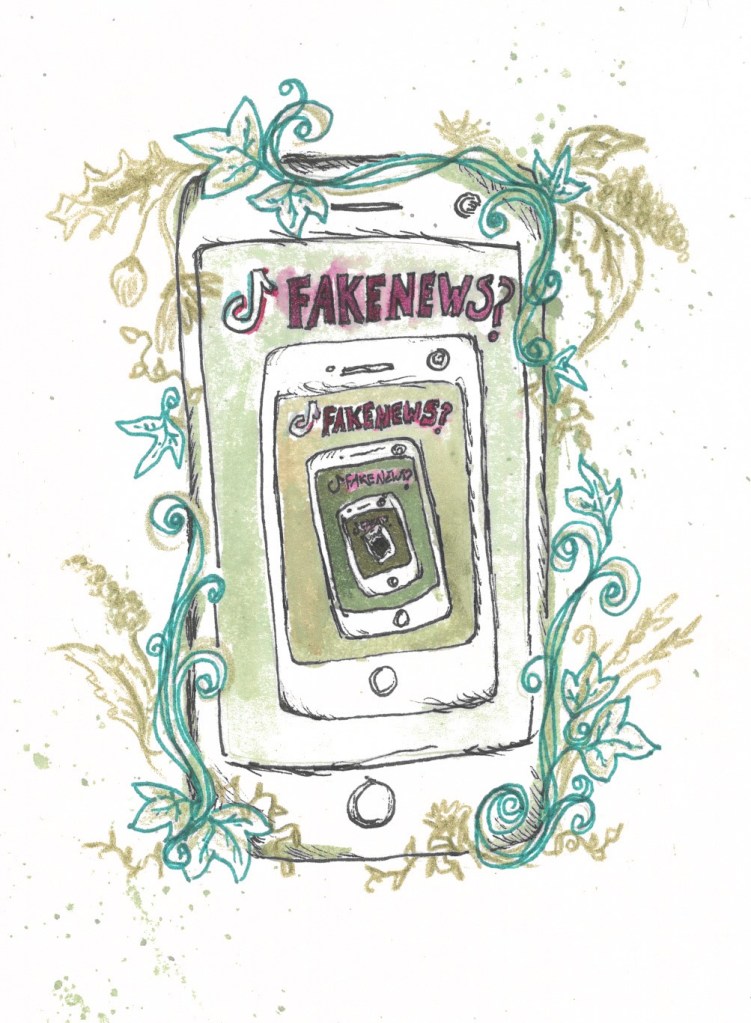
Interestingly, this fake news susceptibility is scientifically backed – older adults are more vulnerable to fake news than younger people due to lower levels of digital literacy. Older adults have less experience critically analyzing internet and social media content than Gen Z teens and adults, many of whom have been using social media for the majority of their lives.
However, the emergence of Gen-Z-dominated TikTok (25% of users are aged 19 and below) begs the question of whether younger generations could be just as exposed to – and susceptible to – fake news as their older counterparts – albeit in different forms and on different apps.
In recent years, TikTok has become an informational and support hub of climate change content. It gives a platform for anyone with an account to weigh in on the climate discussion, to learn about the climate movement and climate news in a short, easily digestible and often comedic form, and to express climate anxiety and stressors with a community of similarly motivated individuals.
As mainstream as climate change information has become, the rise of related content on social media also provides social pressures for children and young adults to stay informed and make positive changes. It allowed the spread of Greta Thunberg’s strikes for the climate to become as popular as they did, as well as uplifting many other protests and stories regarding climate action.
TikTok has also become a popular source of news. A 2022 study found that TikTok is the fastest-growing news source for UK adults and that 27% of young adults aged 16-24 reported getting their news from the app. This is largely because TikTok simplifies both the recording and sharing of news. Many mainstream news outlets have recognised this, and have begun utilising the app to share stories and promote themselves. The New York Times, BBC News, CNN, and many more of the world’s most popular news outlets have TikTok accounts.
For many people, TikTok is an accessible first-hand news source for the climate movement, and other social justice movements, like the Black Lives Matter (BLM) movement. With the revitalisation of the BLM movement in 2020, TikTok users used the platform to document news events as they happened, particularly police violence against BLM protesters.
This does not mean that the app is devoid of misinformation, however – in fact, quite the opposite.
TikTok does have community guidelines which directly state that any content that promotes misleading or inaccurate content is prohibited, and specifically identified climate change misinformation as one form of harmful content which is not allowed. Despite this, a 2023 investigation by BBC found climate misinformation persists on the app, and the videos that are taken down are often recorded and reuploaded by different accounts and still show up on TikTok feeds.
TikTok responded to this report by taking down 76 accounts which posted climate denial content – but the content persists. A study conducted by Pointer, Beeld and Geluid in October 2023 found that out of 240 climate change videos on TikTok, 73 (30%) included misinformation. The study used schoolchildren between the ages of 13-17 to look up climate denial content, who made new accounts to account for biases in their previous algorithms which might affect their search.
Importantly, a stark shift in climate-denial content on social media in the past 5 years has been documented across social media, cumulated in the newly released report. The Center for Countering Digital Hate, used AI to gather data on 12,058 climate-denial YouTube videos and found a recurring trend: climate denial content online is changing.
The study found that while climate deniers used to flat-out deny that climate change is real, this approach is no longer as effective. New climate denial content instead argues three main points: the impacts of climate change are not harmful, that existing climate solutions will not work, and that the climate movement and climate science are unreliable. These three strategies make up 70% of climate denial content on YouTube – and may be harder for apps’ algorithms to catch.
Not only does YouTube allow this content to spread, but it even profits off these videos through ads – up to $13.4 million per year on the accounts studied. While TikTok may not directly profit from misinformation videos, allowing misinformation content to be spread on the app helps grow its reach and user base.
I did some digging and was able to find examples on TikTok of each of the three main “New Climate Denial” themes, linked here: impacts aren’t harmful, solutions won’t work, and unreliable science.
It’s important to remember that while the second video, in particular, is relaying technically correct information, the person is misrepresenting these facts, emphasising parts to fit their agenda while leaving out others, and catering to a particular demographic through hashtags like #climatecorruption and #climatesciencefiction.
In total, these three videos have racked up almost one million views –
The findings of the New Climate Denial report necessitate a reconfiguration of TikTok’s community guidelines and algorithm to target and remove New Climate Denial content – to stop the continual spread of climate misinformation on an app which is the fastest-growing news source among many children, teens, and adults.
In the meantime, falling for fake news isn’t inevitable: there are ways you can avoid falling for dubious headlines and deliberate misinformation on your feed. Fullfact, a fact-checking media company based in the UK, warns users to watch for 5 main things when consuming news on social media:
- Reflect on your own biases when interpreting media.
- Check the poster’s account for red flags impacting credibility.
- Check if people in the comment section have already flagged it as fake.
- Reverse search images.
- Search content on Google to see if credible sources are also reporting it.
So, next time you make fun of your Boomer parents for getting scammed by clickbait posts on Facebook – ask yourself, when’s the last time you shared or repeated news or a fact you learned on TikTok without checking the sources of the video first?
Just something to think about…




 UnEarth Magazine.
Leave a comment