

Words by Mia Cammarota, Art by Leela Stoede.
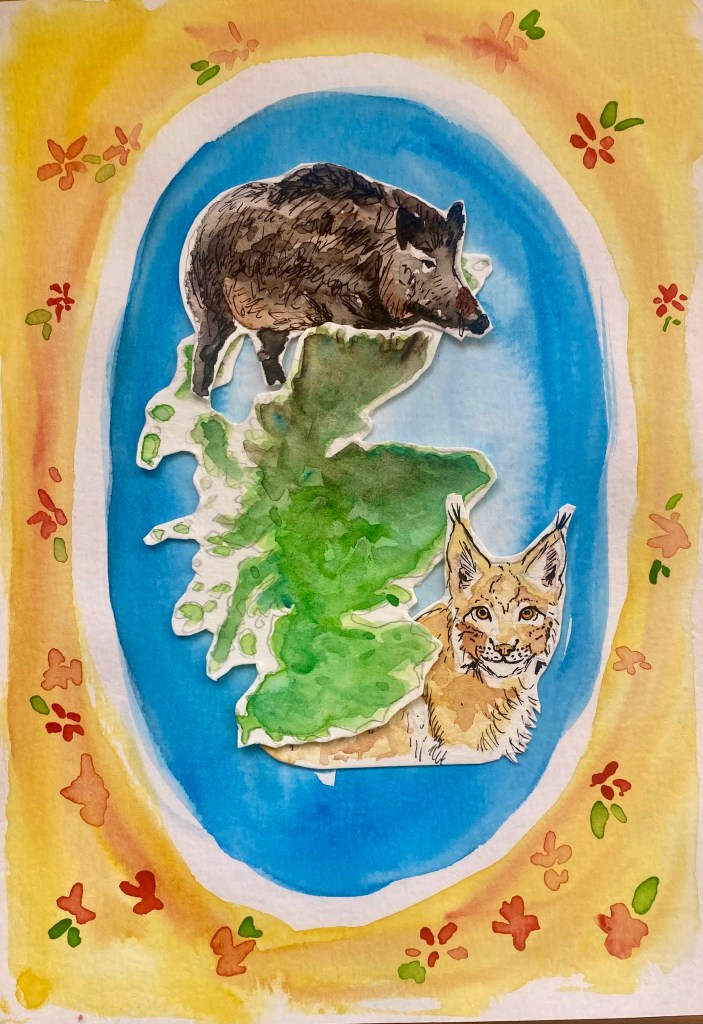
The Scottish wilderness conjures up ideas of remoteness and historical creatures and sparks the imagination; the national animal is the unicorn, after all. In reality, the large carnivorous animals once native to Scotland no longer rule its lands. The extinction of these animals from the country brings up a much less fantastical discussion that is instead surrounded by political, environmental and economic debate. With the arrival of the Anthropocene, there has been a push to rewild ecosystems that humans have overtaken; rewilding is defined as the “restoration of ecosystem function through reassembly of trophic levels involving the reintroduction of large mammals.” Rewilding in Scotland has been a prominent topic of discussion as human impacts become seemingly irreversible.
Ultimately, in Scotland, human colonization led to animal extinction; this mainly happened through hunting and climate change. The modern Scottish environment began at the end of the Pleistocene (15,000-10,000 years Before Present), and native species to the United Kingdom were determined following the formation of the English Chanel (9,500-7,000 BP). Around this time, there were about 1.4 Wild Boar, 100,000 Aurochs, 70,000 Elk, 35,000 Beavers, 20,000 Wolves, and 10,000 Lynx. Intensified agricultural activity in the Bronze Age, the Iron Age, and woodland destruction would lead to the extinction of these species nationally and for the Auroch, globally.
The disappearance of these species and their reintroduction into Scotland does not have a straightforward solution. The Scottish uplands are primarily owned by private estates and managed for game sports. Landowners argue that it would be impossible to rewild Scotland, to a state that reflects a time of naturalness that society and nature have evolved extensively past. These ideas are one side of the argument, and on the other end, rewilding is seen as having the possibility for great success in the uplands. Ecosystems with excessive numbers of deer and difficult soil conditions could be regenerated by rewilding.
Scotland is not alone in debates about rewilding. The introduction of wolves into Banff National Park in 1986 and Yellowstone National Park in 1995 have been regarded as great successes, especially in their role as “ecosystem engineers” and the economic benefit of tourism through wildlife watching. Yellowstone noted that wolf reintroduction has rebalanced elk and deer populations which have positively affected the park’s natural environments like the regrowth of willow and aspen trees along with the end of overgrazing at riverbanks.
Success stories like Banff and Yellowstone only make the voices vouching for similar reintroductions in Scotland grow louder, and some of these calls are being answered. Herbivores in Scotland run rampant with a lack of larger natural predators to prey on them. As a result, trial introductions are possible for Wild Boar and Lynx. Wolves seem less likely, due to a lack of public support, but in small numbers, they could be a possibility, due to their significant effects on deer populations. Through the Scottish Beaver Trial, beavers have already begun their return to Scottish wildlife; this trial has seen economic and environmental benefits.
Whether rewilding is a moral dilemma for humans to rectify the damage caused to natural environments, or the benefits truly could aid Scottish ecosystems and the economy in positive ways, it can only be enabled by the people. Humans have long overturned what is natural to the Earth, and rewilding is a solution that has been trialed and proven successful. Possibly, if large landowners and those who hunt for sport see the bigger picture, they too could reap the benefits of rewilding Scotland.



 UnEarth Magazine.
Leave a comment