
Words by Grace Brady, Art by Cori Birkin, Photography by Grace Brady.
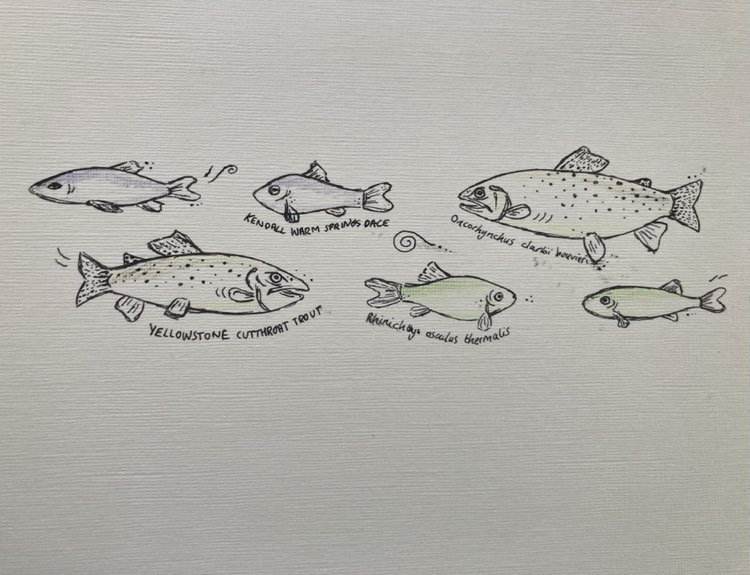
It was mid-May, which is the nice way of saying “late winter” in northwest Wyoming. I could hear the traffic on Highway 89 so clearly, with only a remote-controlled fence between me and the cars. On my other side, the National Elk Refuge, a sprawling alpine plain broken up by spring-fed creeks, was still covered in snow. Despite the name implying elk all-year-round, they only come down from the hills in the dead of winter. That being said, I was not there for the elk. I was there for the fish, which is a recurring reason in my life as to how I end up in places anyways.

Trout art in Teton County.
In the amorphous soup of studying Sustainable Development, I found myself constantly researching sustainable fisheries. Understanding how healthy fish stocks benefit both ecosystems and coastal communities engulfed three of my four undergraduate years. By the start of my 3rd year, I wanted to expand from desk-based studies of fish and gain hands-on experience. The fleeting thought of becoming a biologist crossed my mind. I found a job listing for a fisheries technician post in a mountain town and knew that was the golden opportunity in.
Being a fish tech is not a glamorous job, but I convinced myself it was the type of thing a young, strong-ish, smart-ish girl trying to break into the field would be doing. I was told that the U.S. Fish and Wildlife Service used to require at LEAST a master’s degree in biology to be a seasonal fish tech. At the time, I was not even a normal biologist. I am still in the process of becoming one. Somehow, I leveraged my enthusiasm and a good amount of local knowledge to become the freshest recruit of Fish and Wildlife.
Thankfully, the head biologist took me under his wing once he realised he had given me a tour of this very trout hatchery about twelve years ago, when I came with a school group. We put the pieces together during my first week, and that was a solid enough throughline for a good working relationship. He trusted me with 20,000 juvenile Yellowstone cutthroat trout (Oncorhynchus clarkii bouvieri), as well as another 30,000 trout eggs to incubate and hatch out like some manically overworked mother hen. I spent most of July hunched over troughs of trout fry still absorbing their yolk sacs, carefully siphoning out the leftover eggs and little ones that didn’t make it. These fish are threatened in the wild due to dams and droughts, so the hatchery fish are raised and released into native watersheds to maintain healthy populations.

The view from the hatchery.
I was also put in charge of an endangered species lab attempting to breed Kendall Warm Springs Dace (Rhinichthys osculus thermalis). They are small little minnows with adorably pinched faces. They can only live in one very particular tributary of the Green River and could be easily wiped out in one stochastic event. After writing paper after paper on the global loss of biodiversity, it was mildly jarring to all of a sudden be in charge of more or less ensuring a species does not die out. To be fair, my interactions with them did not extend past feeding and cleaning and trying to get them in the mood to make fish babies (to no avail).
The Kendall Warm Springs are a 30-meter stretch of shallow, geothermally heated springs that feed into the Green River. The first time I went was with my boss, the head of the head biologist, who offered to bring me along to fetch the year’s allotment of dace. The Fish and Wildlife Service allocated us 20 dace to bring back to lab in hopes that the sterile, unfamiliar environment would inspire them to reproduce. We left at 5am and drove east without the radio on, towards the Wind River range. Upon arriving, we were handed a 5-gallon bucket full of fish to pick out and bring back with us. This took no more than 20 minutes, but the beauty of Wyoming is that we spent over 5 hours driving that day within the same corner of the state because everything is zigzagged around the mountain ranges. Before we left, I set up the quarantine tank to welcome the new fish to the lab. They were fed brine shrimp as a reward for their relocation troubles.
The Kendall Warm Springs feeding into the Green River
Dace are sexually dimorphic, with males being a silvery-green, and females are a silvery-purple. This makes it quite easy to tell them apart and play “fish cupid” to pair them up to breed. Every few days, I would mark down which individuals would go to their own little fish Love Island villa (a 5-gallon bucket with mesh windows). Each time, I would hope to come back to eggs. As I came to realise, there is no magic cure to get the dace to breed, which is a classic hiccup in endangered species conservation.
I spent a lot of that summer being deeply sad in beautiful places, but the fish and their needs were a welcome constant in my life. I threw myself into plumbing a 200-gallon aquarium, because following directions on how to connect pipes and build filters was easier than getting introspective. I was floating through the stages of grief, thinking I was working through them like I was working through the steps of rigging a dual stage CO₂ regulator, but that was not the case.
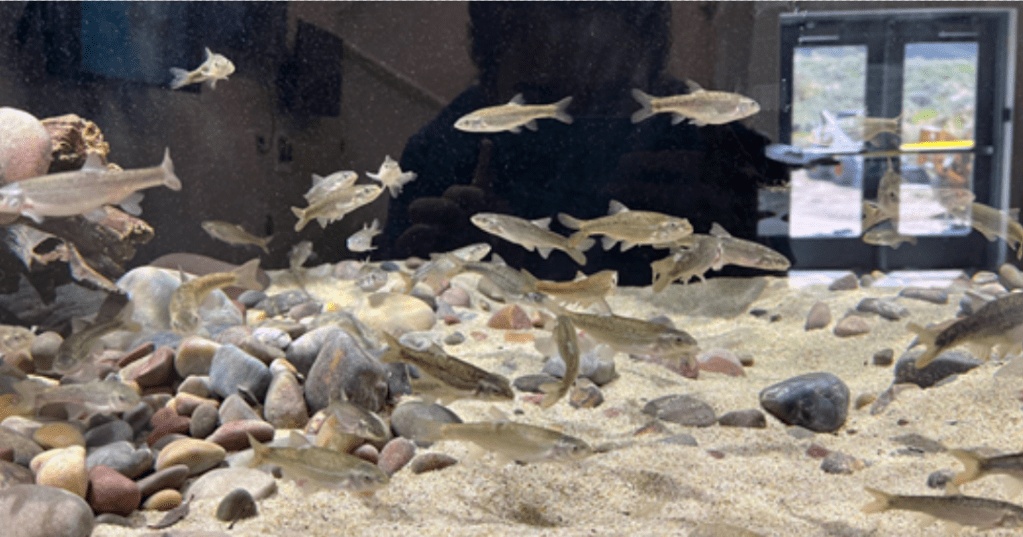
The dace in the aquarium I built.
I like to deflect from taking care of myself by taking care of anything else at all. I live under the false pretence that if everything around me is fine, then by cosmic osmosis, I myself will be fine, too. My work that summer gave me 50,000 other beings to invest my time and energy into. The actual work of a fish tech is a simple rotation of feeding and cleaning, but there is peace to be found in bouts of monotony. I look back on this summer now with fondness, learning so much and so fast. Now in the middle of a master’s degree, that summer of the salmonid was a formative step in my pivot to biology. For the past three years, the fish have dictated my travels and research, and I only see that pattern continuing in the future: following the fish.


 UnEarth Magazine.
Leave a comment