
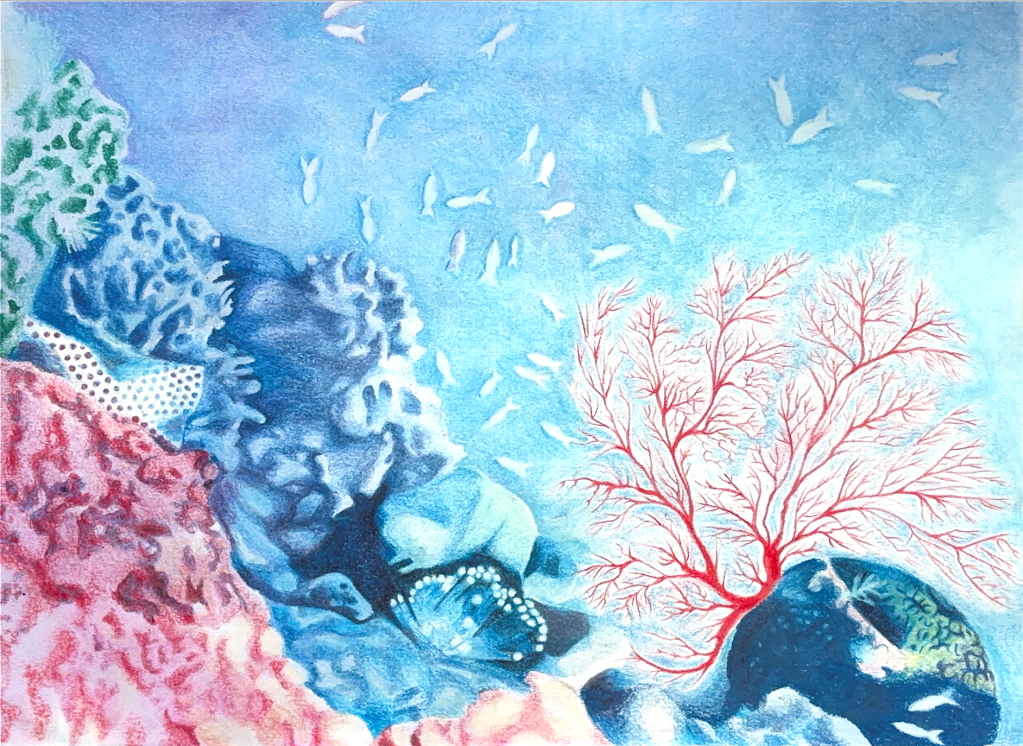
Words by Emily Feeke, Art by Iona Maclaren .
At the gateway to the Mediterranean lies Gibraltar, an overseas British territory boasting a gorgeous landscape, rich cultural history, and a vast array of aquatic life. However, at its southernmost tip, a brown plume can be observed amongst its glistening waters: raw sewage flushed straight into the sea.
This contaminated wastewater, a blend of effluent from toilets, baths, laundry machines, and kitchen sinks, is not simply evidence of the daily activities of the over 30,000 inhabitants on the small peninsula but presents a significant environmental concern. The decomposition process of the organic matter it contains consumes a considerable amount of the oxygen in its waters, leaving less for the species that call it home. While some local scientists in Gibraltar argue that Gibraltar’s unique position at the confluent of the Mediterranean and Atlantic leads to the rapid dissipation of the wastewater, preventing the formation of such dead zones, further ecological risk is presented by the inorganic matter it contains. Raw sewage can and does contain other substances like pharmaceuticals, cleaning products, and personal hygiene products which can pose a biohazardous threat to human health and wildlife. Furthermore, items like personal hygiene products are not biodegradable and hence do not break down in the sea.

Some of the repercussions of this long-term dumping are already starting to be observed in Gibraltar. In February this year, it was reported that beaches in Gibraltar were littered with hundreds of wet wipes that had washed onto their shores, along with the shoreline of its neighbour, Spain. Although this occurrence was not directly linked to Gibraltar, the correlation cannot be neglected.
This problem was set to be resolved a considerable time ago. In 1991, EU legislation banned the pumping of sewage directly into the sea without treatment, and in 2015, Gibraltar’s lack of a sewage treatment plant landed the UK government in trouble with the European courts due to the direct breach of this legislation. However, at this time, steps towards the rectification of this issue had already begun. In 2011, when the GSLP party came into power in Gibraltar, a key point in their manifesto was the building of a sewage treatment plant and in 2014, a joint venture had finally been awarded to Northumbria Water and Modern Water. This was meant to be a significant step forward in the actualisation of the manifesto promise and was set to cover the design and survey work required for the project’s planning and environmental approval. After the award of the project, little was heard with respect to its progress until 2018. The amount of time required for planning was attributed to Gibraltar’s unique situation due to the high salinity of its effluent water, a result of sea water being used in the toilets on the Rock*. The high salt concentration of the sewage was shown to have a negative impact on the biological matter that is typically employed to treat this kind of waste Northumbria and Modern Water claimed, however, that they had found a solution and with their new proposal, the building of the plant was finally set to begin in 2018 with its completion in 2020. Why now in 2024 has this still not been made a reality?
Modern Water went into liquidation and Northumbria Water was unable to carry on the project itself resulting in a long legal process involving the closing of the previous treatment plant tender and its reopening to bidders in a highly competitive process. Little was heard again from the government during this time, until June 7th, 2023, when ECO Waters LTD was announced the new management of the project, with promises to provide an environmentally conscious wastewater treatment plant. The chosen company shows promise for the job as it plans to implement Nereda technology, which is currently used in 100 plants in 22 countries and requires less energy and space than many alternative options. This is valuable given the limited land available on the 5 km long stretch of the Iberian Peninsula. Furthermore, the Nereda technology is well fitted for the plant as the biological matter used to break down the effluent waste is contained in a granule system, which enables it to be resistant to the high saline content of Gibraltar’s wastewater.
After 13 years, hopefully 2024 will finally bring wastewater management to Gibraltar with the materialisation of the promises of the 2011 manifesto and an end to Gibraltar’s stinky situation.
Curious about updates with the progress of this project? Check out the following Twitter account! https://twitter.com/gibsewage



 UnEarth Magazine.
Leave a comment