
Words by Violet Melcher, Art by Cori Birkin.

Have you been told life after graduation isn’t going to be easy because of the employability of your chosen degree? Green careers and degrees are relatively new to academia and have been an icebreaker in many conversations here in St Andrew. Your chosen degree is often one of the first things someone learns about you during your initial days at university, and being told there is no demand for your field is a blow no matter how kindly it’s said.
There are a few STEM degrees that often fall under the umbrella term of soft sciences: fields that when brought up in conversation are met with “you’re not going to find a job once you graduate” or a similar subtle reference to a field’s value and real-world application, Sustainable Development (SD) and Geography often fall into this category. Both of which centering on research as well as fieldwork and concerning some of society’s most pressing problems including the climate crisis, changing population dynamics, global inequalities, and biodiversity loss. These are topics often integral to conversations about required adaptation and mitigation to counteract global climate change in the coming years. The real-world need for green degrees is not always recognized, however there’s hard evidence to show how big of a role they truly play.
However, with the UK’s commitment to achieving net zero carbon emission by 2050, thus reducing national reliance on fossil fuels, many industries will be reshaped with renewable energies and environmental protection on the forefront of their priorities. This shift will open the space for the creation of countless opportunities for those who have studied green innovations and policy – topics directly related to degrees such as SD and Geography. Even sooner than 2050, the UK’s Ten Point Plan established in 2020 has set the goal of creating 250,000 new green careers by 2030.
Recent studies show that green jobs are growing nearly four times faster than the average position in the UK job market. Data collected from 2016 to 2021 shows that positions such as sustainability manager, solar consultant, and general jobs in ecology have grown the most globally compared to other career choices. In 2015, there was an estimated 507,000 full time equivalents (FTE) for employment in green jobs in the UK while in 2020, this number grew to 526,000 FTE.
Additionally, as green jobs expand and become, not only more common but also even more essential, further industries will be creating green jobs. Fields including finance, fashion, and transport have all been traditionally less green. Yet, recent initiatives have led these industries to create new jobs for people who specialize in a variety of environmentally focused interests.
Global data from 2020 to 2023 shows a pattern in expansion within green technology and sustainability careers, with projections continuing to rise until at least 2030.
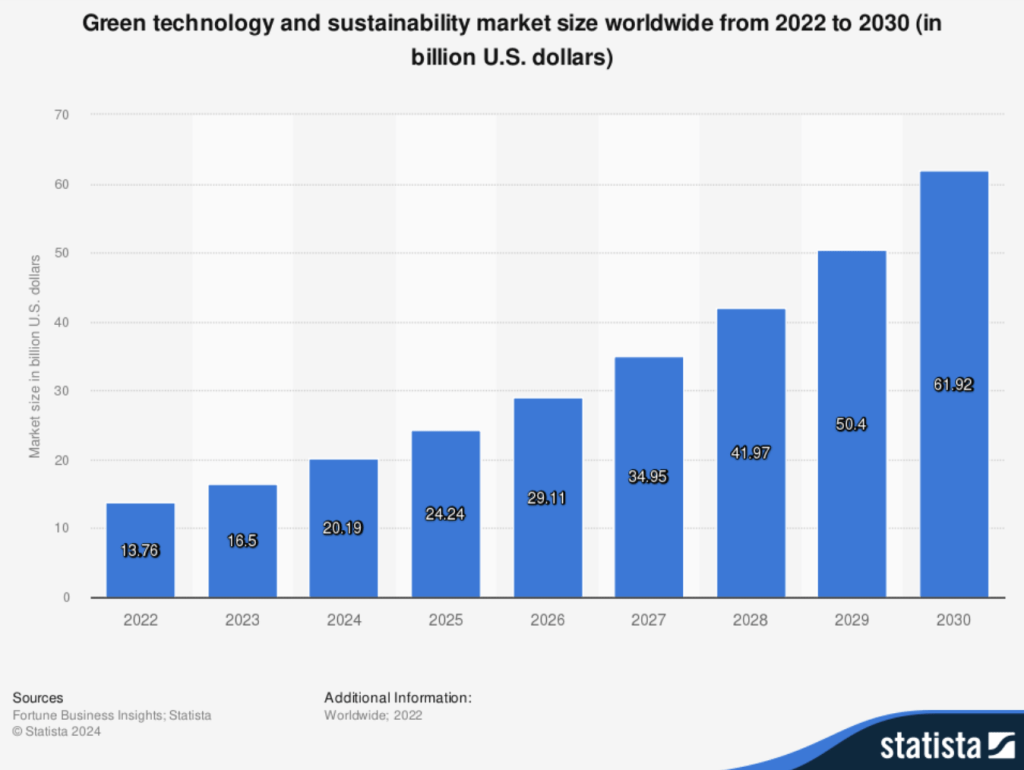
Figure 1: Green Market Size Globally 2022-2023, From Laricchia (2023)
With a continued projection of market growth as shown in Figure 1 and no real reason why this would halt, when you get met with a “You’re never going to get a job after you graduate” or some similar comment, at least now there’s hard data showing how factually incorrect that person is. Green careers are needed and so are you! https://action.deloitte.com/insight/3340/an-overview-of-green-job-growth
https://www.weforum.org/agenda/2021/09/sectors-where-green-jobs-are-growing-in-demand
https://www.irena.org/Digital-Report/World-Energy-Transitions-Outlook-2023




 UnEarth Magazine.
Leave a comment