

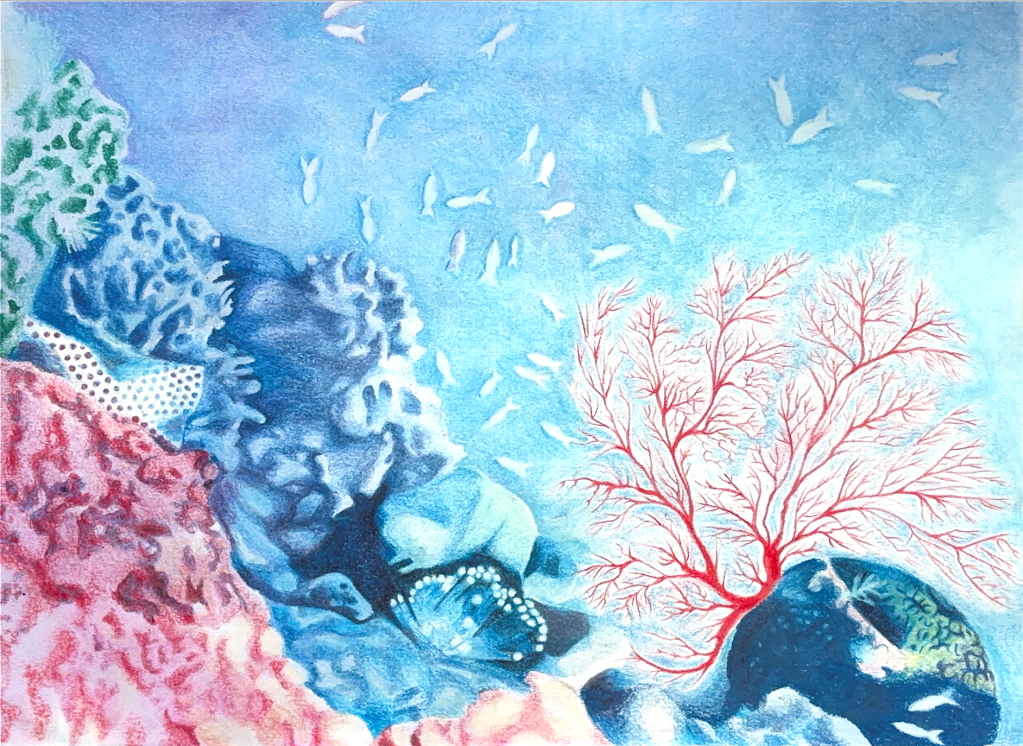
Words by Rowan Hunter, art by Lydia Allan.
Job posting: Chatham Island Light Station Keeper. Applicant must be willing and able to relocate to a remote work site and live there alone for periods of up to three months. […] All ensuing risks are knowingly undertaken.
The light station was uglier than you’d expected. The keeper’s house was squat and disappointingly modern, clinging to the rock by the treeline; the light itself was small, as lighthouses go, and awkwardly crowned with the plastic antennae of a weather reader. You’d read into the history of the island. Once crawling with loggers and fishermen and a cannery, like everywhere up the coast, everyone had moved on in the seventies and left very little besides rusty junk on the beach and bare, jagged rock. Over the years, the trees grew back dense and dark, the forest swallowed the town, and the cannery fell piece by piece into the sea. You’d known this, yet still had not been prepared for the sheer emptiness of it all.
No birds sang the first morning, or the second, or any other. Your daily VHF calls to the Coast Guard to report the weather were your only connection to the outside world, and as the days darkened into winter, the signal got weaker and weaker. You’d already read all the books you brought. Time stretched ahead of you, vast and unforgiving as the iron-gray sea. What was left to do but explore?
Down on the beach, you look up towards the forest to see a mossy path you’ve never seen before, leading up through the bush. It is impossibly clear and well-maintained. As you step past the treeline, something white catches the corner of your eye. Up the hill lies the skeleton of an old church, its whitewashed beams falling in but unnaturally clean, the bleached ribcage of some giant animal; you realize that within a perfect circle around it, absolutely nothing grows. The soil is parched and crackling despite the season. Over the door, you can still read the fading words: “…subdue the earth, and have dominion over the fish of the sea, and over every living thing that moveth upon the earth…”
Suddenly, a flash. Lightning strikes the old spire, but it is not the church that burns. A longhouse stands aflame before you, intricate posts bracketing a door pouring out smoke and people who are clearly sick, lesions marring their faces as they stumble, coughing, into the forest. But where the forest once was, now is nothing but a burned, barren rock. Those who still stand recoil as a raven lands before them and transforms, first into something with a black book for a beak and black wings that choke the world, and then into an inferno. The fire hisses, swirls, expands—the trees burst one by one like Roman candles—you turn to see the path out growing in on itself, invasive blackberries crawling, obscuring the ground.
You run. They tear at your skin, vicious, but you know somehow that if you stop, your whole body will be imprisoned forever in the sharp vines that gleefully grow ever onwards, ever upwards.
If only the beach could’ve saved you. If only you could’ve looked away.
Twenty feet above the water of the bay, mid-air between the leaning, creosoted cannery pilings, stands a woman in a long skirt and apron. She bends, grabs a salmon from a metal bucket, throws it onto the cleaning table before her. You are transfixed. You want to tear your eyes away, yet you cannot turn your head. With practiced strokes, the woman before you who should not be there slits the salmon throat to tail, guts it, skins it, throws the flesh to one side. Again, and again, and again, every impossibly mechanical twenty seconds, shining silver fish made pink, glistening, unrecognizable.
You cannot stop looking. The woman’s apron drips slime and blood and the thin, wicked knife in her hands flashes, impossible to tell from salmon skin until the cut is made. Suddenly, though, there is nothing left to cut—her hands search left and right, coming up empty. She looks up; your eyes meet. Hers are glassy. Dead.
Quick and methodical, the knife rises again and plunges deep into the hollow of her throat, borne down with two hands through her gut. Cloth, skin, viscera, indistinguishably saturated with gore, slough away until only the pink, glistening, unrecognizable flesh remains, twitching.
The knife falls onto the slick metal cleaning table with a clang. Another woman, identically dressed, steps into her place, picks it up. She looks straight at you—don’t you wish you could look away? —and she beckons.



 UnEarth Magazine.
Leave a comment