


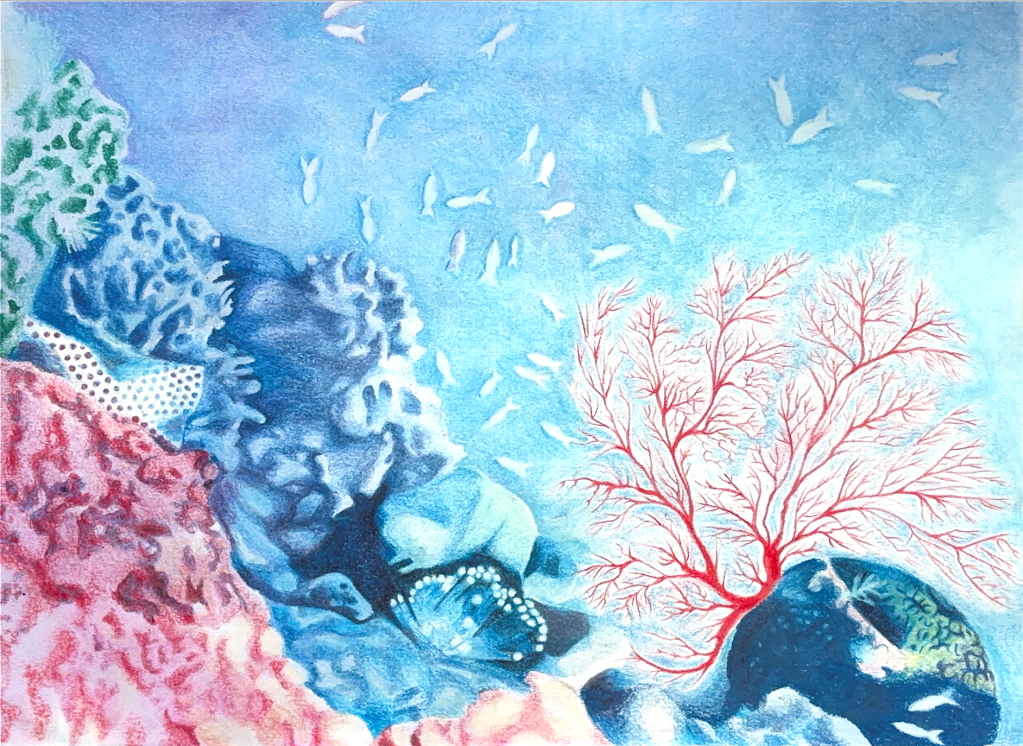
Words by Hannah Tuinmann, art by Ester Burgerova.
The landscape of many Bahamian islands was almost entirely flattened following the arrival of Hurricane Dorian in 2019, a category 5 hurricane fueled by the increasingly warm waters resulting from climate change. The only nature left standing on islands such as Abaco and Grand Bahama were the split trunks of Bahamian pine trees and ravaged low laying shrubbery.
The dramatic devastation forced local government and environmental organizations to reflect on the role certain species of plants and animals play in the upkeep and protection of ecosystems.
The Bahamas National Trust conducted a report on the post-Dorian environmental impacts, highlighting deforestation, a dramatic decrease in bird population and the death of two whales. However, what was particularly interesting was the renewed attention given to mangrove rehabilitation as around 70% of mangroves were damaged on the island of Grand Bahama and 40% on Abaco.
Otherwise known as “walking trees”, mangroves, in many cultures, symbolize strength and support as they withstand consistent tidal level changes in saltwater and reinforce coastlines in extreme heat. There are 80 different species of mangrove trees, and they can be found growing in intertidal areas in warmer regions near the equator between Florida and Argentina; mangroves cover around 1% of the planet. About half of their long roots are buried into the bottom of the waterbed and the other half stick out and form shrubbery, looking almost like spider legs.
Mangroves are a relatively undiscussed group of plants and were only included last year as part of the Nationally Determined Contributions in the Paris Agreement. There are two main reasons why mangroves are important: they support climate regulation through their ability to capture carbon and they are instrumental to biodiversity.
Mangroves store approximately 1,000 tonnes of carbon per hectare in the soil beneath them and in their own biomass. The low-oxygen conditions found below the roots of mangroves cause the deceleration of organic material decomposition which allows mangroves to store carbon that is absorbed from the atmosphere. Recent evidence from a study in Australia suggests mangroves may help hinder ocean acidification by exerting “dissolved inorganic compounds and alkalinity”.
According to the United Nations Environment Programme, around 1,500 species of plants and animals are dependent upon mangroves, including smaller fish, who use the mangrove root forests as nurseries to breed as larger predators cannot access the area, and birds, who use the trees for shelter and nesting. In Sri Lanka, mangroves are home to around 15 species of mammal, 13 species of reptiles, and 2 species of amphibians; their shelter of entanglement is like no other.
Mangroves are considered one of the most threatened wetland ecosystems in the world because they have been cleared for expansion of shrimp farming, for coastal developments (such as installation of ports and docks) and for the production of charcoal and timber, resulting in deforestation. Additionally, hurricanes supercharged by increasing global temperatures have been another contributing factor to mangrove deforestation. The IUCN Red List of Ecosystems, a 2024 global assessment on the health of mangroves, determined that 50% of mangrove areas are at risk of destruction.
But what is the difference between mangroves and other types of plants that form an ecosystem? Lots of other types of plants are affected by human activity, so why is special attention being given to mangrove restoration? Well, as many Caribbean leaders and international organizations have recently discovered, they provide a ‘nature-based solution’ to climate change. Mangrove roots lining coastlines can help absorb the impact of waves and alleviate the pressure of rising sea levels on coastal communities, especially during hurricanes.
Hurricane Dorian spurred this revelation, and as part of their renewed disaster management strategy, the government of The Bahamas have engaged with several mangrove restoration initiatives. One of these includes the Bahamas Mangrove Alliance which has recently launched the One Million Mangrove Commitment as a response measure to Hurricane Dorian. This commitment aims to plant 1 million mangroves by 2026 and involves an extensive 36-month replanting project.
Additionally, a smaller initiative called the National Mangrove Project approaches the issue in a ground-up fashion by specifically providing mangrove kits that allow students to go out and plant their own mangrove propagules and seeds. Having limited economic and human resources, the ground-up approach is quite popular within Caribbean governance projects relating to preserving the environment and natural disaster recovery.
International support for these projects has also been fundamental to their efficiency and global exposure. For example, the German government has worked with more than 50 projects within the International Climate Initiative that specifically addresses the need to conserve and preserve mangroves. Additionally, the United Arab Emirates, in collaboration with Indonesia, have also been introduced as a ‘nature-based solution’ to the climate crisis with their launch of the Mangrove Alliance for Climate in 2022.
Mangroves are a scaled-down example of the interconnectivity of the climate crisis. The plants are fundamental to coastline and biodiversity protection, both in the water and above it, and are being destroyed by pollution and increased intensity of hurricanes. However, while they are victims of climate change, mangroves are also a solution that is being explored on an international level.
Creativity, combined with the growing knowledge of environmental resource benefits, will significantly help fuel projects that can alleviate the strain of the growing climate crisis. The next stage of discussion for environmentalists and governments is to explore other nature-based solutions that small island nations and other tropical islands can utilize in their frontline fight against the climate crisis. Continued international cooperation and awareness of these projects will be instrumental to their survival going forward.


 UnEarth Magazine.
Leave a comment