
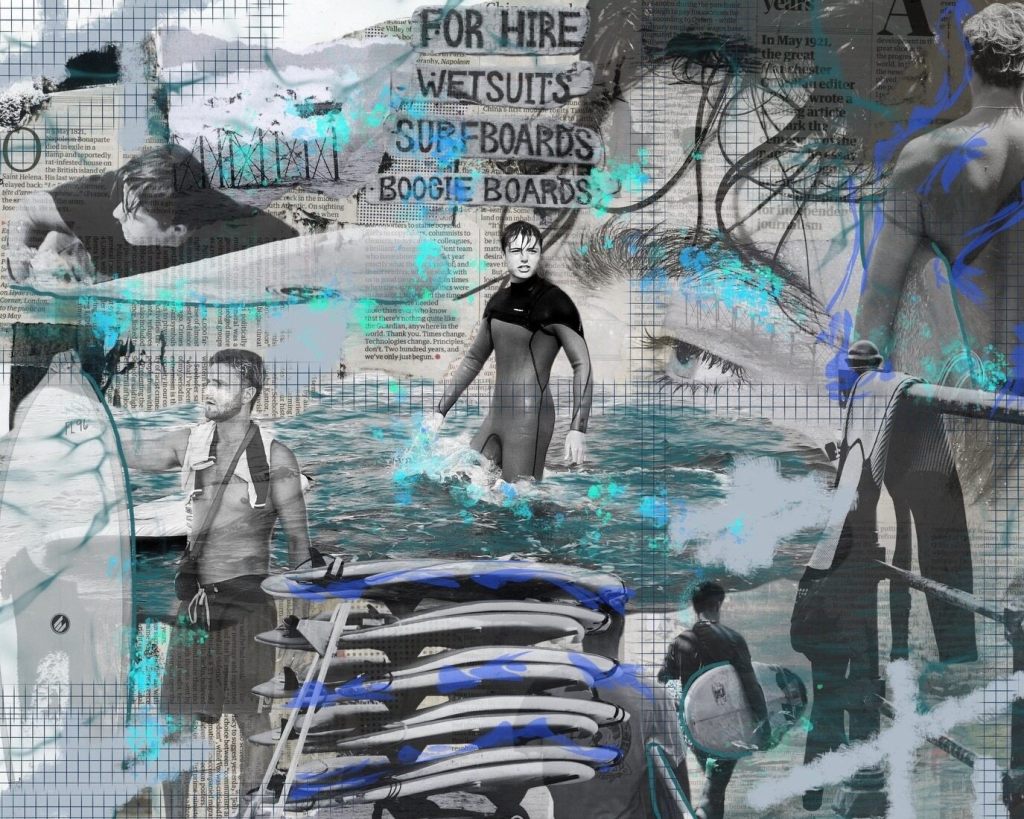
Words by Katie Gretter, Art by Jessica Nunn.
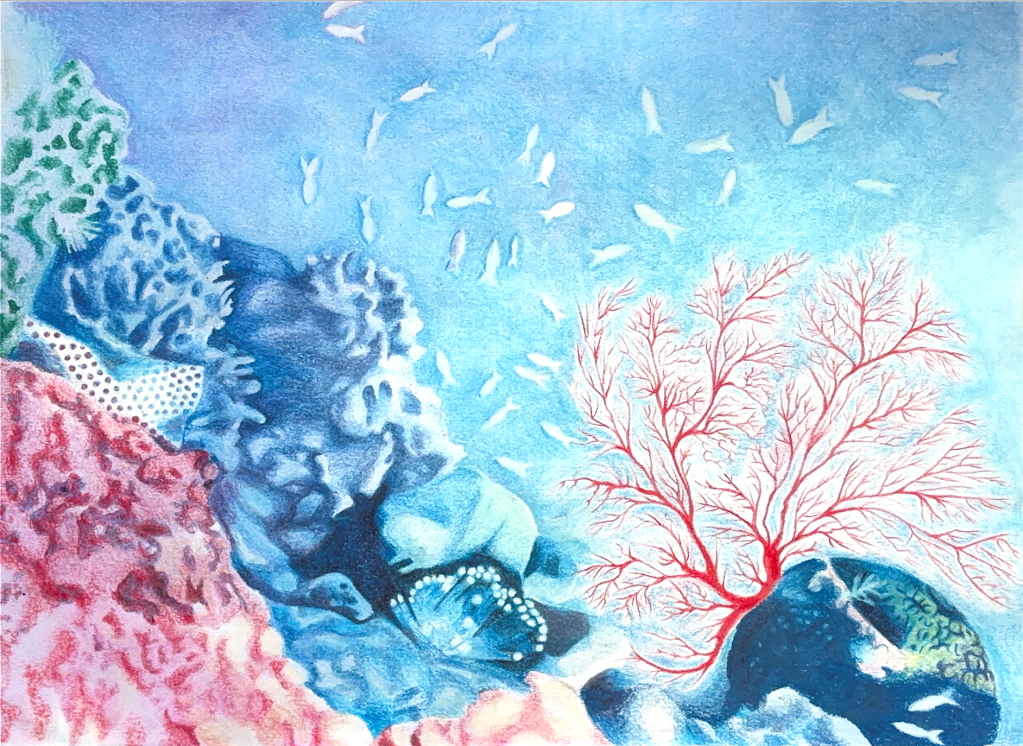
To start this off, I’m not a surfer; I’m a diver. I always wished I could be coordinated enough to stand up on a board and ride a wave, but as a 5’11” girl who never mastered her limbs, it’s never been in the cards for me. Despite this, I love the ocean, and I think I have a lot in common with surfers. I have always felt largely alone in this dire anxiety to protect coral reefs and coastal ecosystems because I have seen firsthand the damage it does, and I think surfers are one of the closest interest groups to do the same. So when I heard about how organizations were looking into surfing to be a means for governmental and policy protection of these systems I was immediately intrigued.
It is important to note that many reefs have formal protections through National Marine Sanctuaries. Unfortunately, we have lost 30-50% of global coral reefs already. Global carbon emissions have remained one of the largest threats to reefs as they cause ocean warming and acidification. Additionally, corals are threatened by coastal development, overfishing, and pollution runoff from land-based activities.
New studies found that ‘surf ecosystems’ – the coastal areas surrounding major breaks – hold 88.3 million tons of carbon. However, less than ⅓ of these ecosystems are protected. Many of these sites are made up of mangrove forests which are particularly important as these trees can store up to five times the amount of carbon as terrestrial trees. Mangroves are also vital for biodiversity as they are important nurseries for birds above water and fish below. Finally, mangroves are important to protect ocean ecosystems from urban environments and vice versa; the trees filter runoff pollution, stabilize coastlines, and provide protection against storm surges. Despite this, over half of the world’s mangrove forests have been lost in the last 50 years.
This is where surf conservation comes in. Surfing generates $60 billion annually, with over 35 million people participating in the sport.Surf conservation allows for formal mechanisms under which ocean and terrestrial ecosystems can be further protected. Surfing is a vital connection between land and ocean, which is often a missing step in formal coral protection. Moreover, surf conservation brings recreation and economic needs into formal protection. The light-hearted and common ocean-use practice can allow governments and citizens to re-engage with marine and coastal environments. Spreading interest in the ecosystems is how we can ensure they are protected.
The first surf conservation law came into effect in 2014 when Peru established Ley de Rompientes or ‘Law of the Breakers,’ which gave the waves legal protection. Following the implementation of this law and the push for more surf conservation mechanisms, the idea of ‘surfonomics’ has grown, whereby politicians have a better social and economic justification for conservation backed by practical recreation utilized by numerous ocean communities.
As the idea has evolved in recent years, coalitions like the Surf Protected Areas Network (SPAN) have expanded the scope of their locations as well as the impact the protected areas have. Recently, the program has been working in the Azores where they have held workshops and brought together stakeholder meetings. After learning local needs from recreational surfing, economic, and environmental perspectives, SPAN and its partners can help draft legal frameworks to be formally implemented by policymakers and local governments.
Conservation International has also worked to establish a series of surf protections alongside partnerships with organizations like SPAN. So far, they have protected over 70 surf breaks and 80,000 hectares with plans to continue expanding the project. So far, these surf conservation projects have occurred in Indonesia, Fiji, Hawaii, Costa Rica, Peru, and Brazil.
On the other hand, there is worry that surfing and tourism can be a destructive practice through travel emissions, petroleum-based wetsuits, and reef-damage through chemical sunscreens. Moreover, some argue protection of natural ecosystems solely for the benefit it brings to humans is an unsustainable view for conservation in general.
However, I think it is important to begin conversations about how surfing can be made to be more sustainable, perhaps having mechanisms to ensure that surfers are using reef-safe products on the reef. Unfortunately, we have passed a time when we can consider how we change people’s perceptions, and we need to drive interest so that environmental preservation can progress here and now. I hope that surf conservation provides another avenue through which we can recognize ocean protection and continue protecting our planet for future generations, and as a diver, I’m happy to have another interest group respecting and caring for the beauty of our ocean.



 UnEarth Magazine.
Leave a comment