
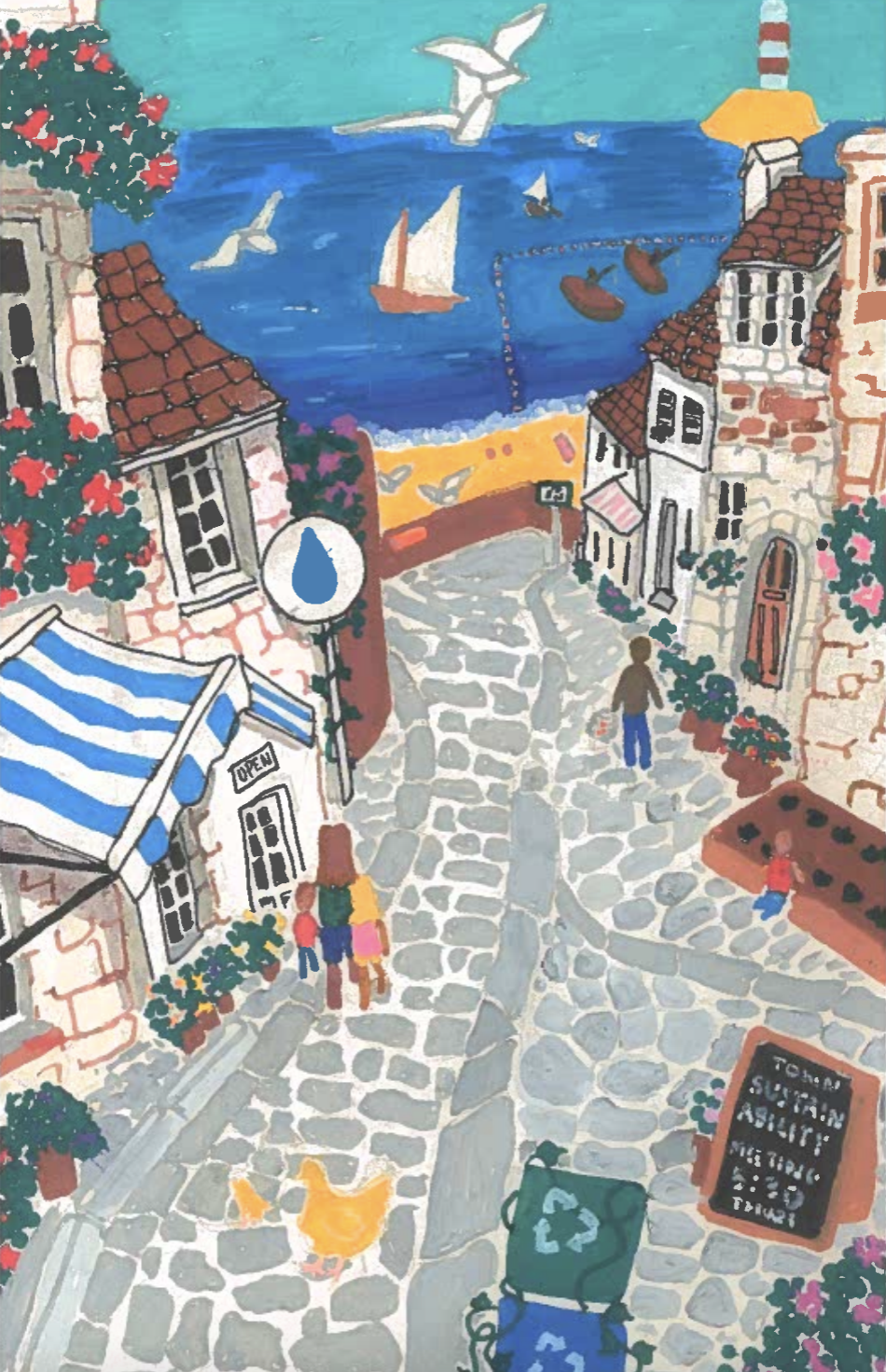
Words by Margaret Chingos, art by Ru Todd.
For my convictions and journalistic integrity, I should begin this article with the admittance that I am a staunchly left-leaning girl. For me, this political leaning has always come with the assumption that government is a good thing. I have always thought that bureaucracy builds a better world and that addressing global issues is best achieved through embracing governmental power and expansion.
However, my conviction that the government is the best tool for positive change was recently challenged.
I spent my summer living 12 miles off the coast of Maine on an island called Monhegan. The tiny island, with only 60 year-round residents, couldn’t have felt further from the ‘real world.’ Traces of civilization I was used to were absent or modified. Instead of police, there was a singular constable, Facebook groups were replaced by a noticeboard on the side of a shed ‘downtown,’ and broadband internet was installed for the first time in June.
These absences extended governmentally, giving the place a self-proclaimed feeling of ‘lawlessness.’ Over months of poker nights and scrubbing dishes alongside locals, I got to know the people who call the island their home and politics gradually crept into our conversations. While everyone has their personal views, there was a strong feeling of political independence that prevailed in many of the encounters. The sentiment was that governmental influence was something that belonged to the mainland, not Monhegan. They have been doing their own thing out at sea for generations, and frankly, it’s been working well.
Naturally, this came as a shock to my liberal sensibilities. Monhegan still adheres to laws in both theory and practice—it’s not the Wild West. However, some of the population feels that they exist in a “lawless land” beyond governmental oversight.
The assumptions I made about this sentiment were negative. In my mind, the government fights for the common good. Without its presence or embracement, individuals will act in personal interest leading to a litany of issues, especially surrounding the tragedy of the commons.
To my surprise, Monhegan is one of the most sustainable communities I have encountered. The island has a variety of community-based sustainability initiatives that allow them to live lightly on their rural lands.
They have self-declared conservation zone around the island that prohibits lobstering in the summer months. These preserved waters allow the island to designate that only island residents can lobster in them, which treads lightly on their ocean resources, and contributes to the economic sustainability of the community. Moreover, MISCA, the Monhegan Island Sustainable Community Association, contributes to community sustainability by securing affordable housing for full-time residents. And finally, the island participates in an almost militant recycling routine that puts most mainland cities to shame. Yet there is no large government presence telling them to carry out these projects.
I spent some time grappling with this dichotomy caused by my preconceived notions. Monhegan has a culture that rejects the actors that I believe create positive change, and the island continues to be one of the greatest models of sustainability I have seen. This experience challenged my assumption that government is the primary place from which positive change originates, which allowed me to embrace alternative forms of action that I would have otherwise written off entirely.
In the case of Monhegan, this lawless sentiment manifests itself in a spirit of self-sufficiency. The sustainability efforts I mentioned are all the result of the community taking matters into their own hands because they felt no one else would. The community solutions that came as a result are uniquely successful due to their small scale, which allows for flexibility to trial strategies and morph solutions to fit the specific place and culture. The implementation of the programs was more successful because members of the community felt involved in their creation. This is not a place that likes being told what to do, so a collaborative approach was the only way forward.
Monhegan has taught me to look to the lawless lands. The places that are pushed out to the periphery are often engaged in positive action that embraces self-sufficiency. Slipping under governmental radar has made these populations experts in independently taking charge. They embrace solutions that are creative and locally effective —providing inspiration to communities everywhere.



 UnEarth Magazine.
Leave a comment