

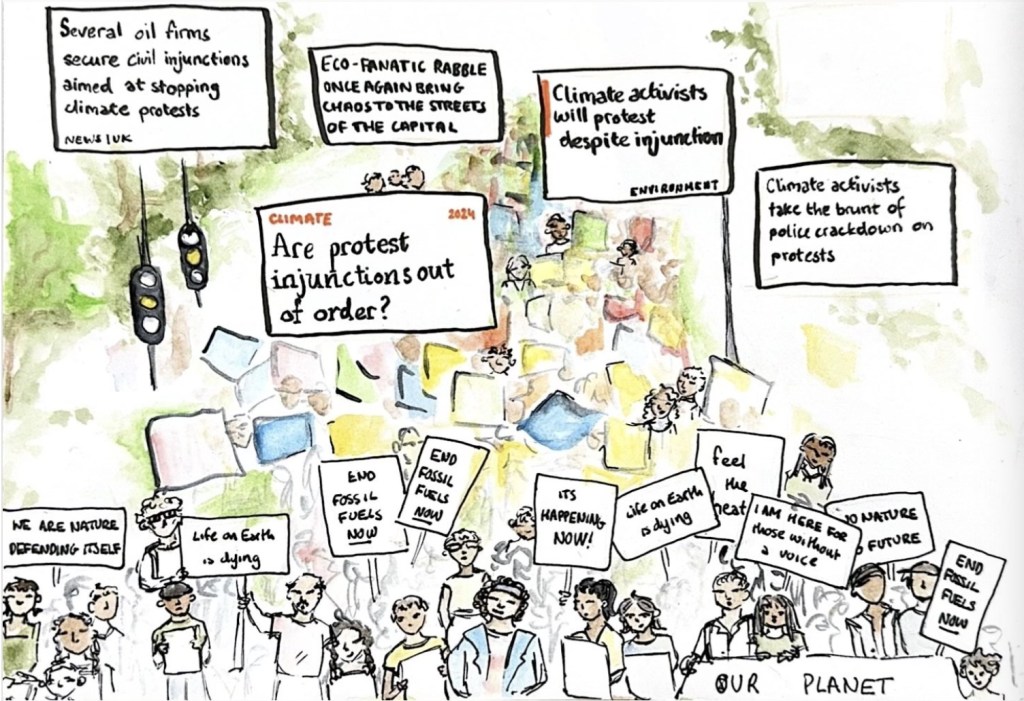
Words by Siena Keijsers, art by Cori Birkin.
Civil injunctions are legal orders obtained by corporations and public bodies which restrict certain actions, often targeting environmental protests. Injunctions can be imposed on individuals or groups to prevent activities on the grounds of trespassing and interference with commercial activity. Civil injunctions have recently proliferated across the UK. For instance, slow-walk protests are banned at over 1,200 locations. Eight have been issued by oil companies, namely Shell, Esso and ExxonMobil. National Highways and Transport for London account for five more. Others have been taken out by local councils, such as North Warwickshire, Essex and Thurrock. Injunctions can be directed at specific people, or ‘persons unknown’. The latter means the injunction applies to the entire public. For instance, the High Court has imposed a persons unknown injunction along the entire proposed route for the High Speed 2 (HS2) railway project. Injunction breaches warrant an unlimited fine and imprisonment for up to two years. In the case of HS2, breaches resulted in 268 days of imprisonment.
So, why are these civil injunctions unjust? Injunctions reinforce power imbalances between corporations and activists and deter efforts to tackle ecological problems by undermining free speech and peaceful protest. Whilst corporations can afford the legal resources required to secure injunctions, activists often lack the means to challenge them in court. Applications for civil injunctions are rarely challenged because legal aid is not available for the initial hearing. Those who attempt to contest an injunction face the risk of being ordered to pay their opponents’ legal fees. For instance, National Highways is now passing on the costs of pursuing injunctions to the case’s defendants. Those injuncted have been charged £1500 to compensate for National Highways’ legal fees and are expecting to be charged £5000 more. Even adhering to the terms of the injunction does not protect you from having to shoulder the plaintiff’s legal fees. In contrast to criminal law, there is no limit to the proportion of a prosecutor’s legal costs that can be imposed on the defendants. This financial burden serves as a deterrent, making it nearly impossible for activists to peacefully protest without severe repercussions.
Additionally, penalties for breaching injunctions are often more severe than for related crimes. For instance, aggravated trespass has a maximum penalty of three months’ imprisonment and a fine of up to £2500. Yet, an injunction breach warrants an unlimited fine and imprisonment for up to two years. Civil injunctions also add to any penalties incurred under criminal law, so protestors can face multiple prosecutions for the same offence. In restricting and deterring peaceful protest, these injunctions subvert an essential aspect of democracy. Whilst I believe it is acceptable for road networks to take out injunctions to ensure emergency vehicles can move freely, injunctions imposed for all other reasons are an insult to the rights of the majority. For instance, the custodial sentence issued to Sarah Benn, a retired GP from Birmingham, for peacefully protesting on a grass verge and sitting on a private road outside Kingsbury Oil Terminal entirely undermines our right to peaceful protest. Historically, protest has been a key vehicle for societal change, from the suffragettes’ fight for voting rights to workers’ demands for labour rights. Stifling environmental activism limits public awareness and hinders policy change.
Ultimately, civil injunctions function as a privatised justice system, lacking the safeguards found in criminal law. Activists face unlimited fines, two years in prison as well as the financial burden of their opponents’ legal fees. As the need for environmental action grows more urgent, it is vital we protect our right to peaceful protest and prevent legal mechanisms from prioritising corporate interests over public advocacy.



 UnEarth Magazine.
Leave a comment