

Words by Izzy Gimson, art by Zoe Henderson.
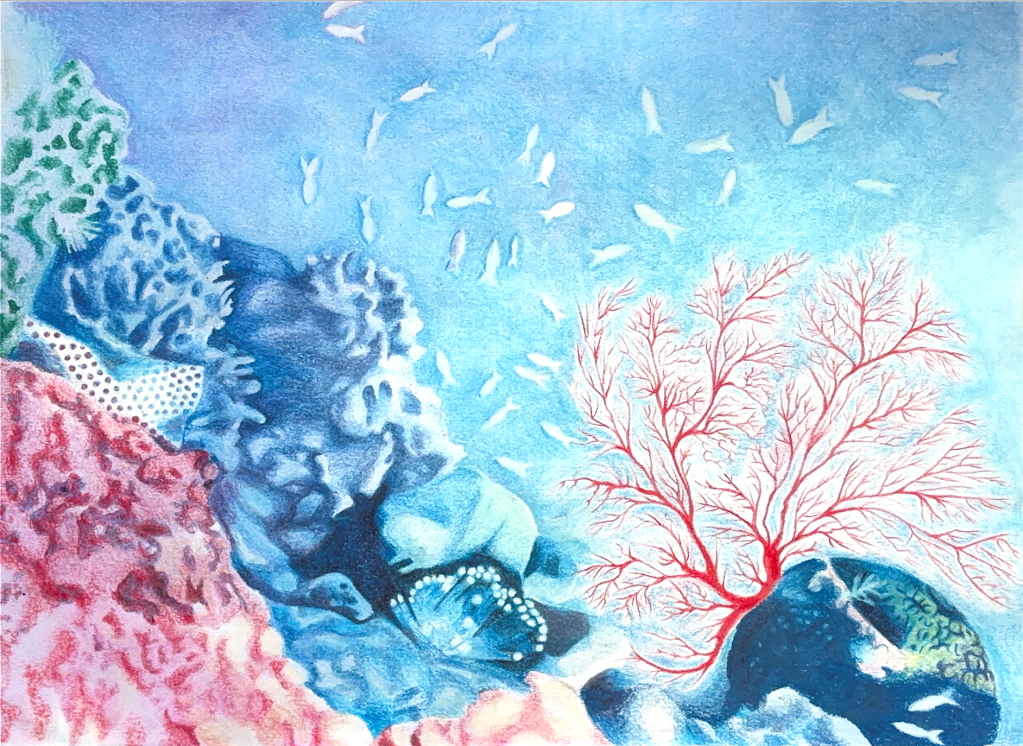
How many of these local Fife species can you name?
In 1962, Rachel Carson published Silent Spring. Its title presents a bleak vision for a future spring without birdsong, due to the indiscriminate use of chemical fertilisers. Her critique, then an exposé of the pesticide industry and of government failings to appropriately regulate it, remains relevant in today’s context of continued environmental degradation and exploitation. But what happens when the silencing of birdsong is no longer so dystopian, and goes almost unnoticed? Local environmental knowledge and our connection to it, like our local environments, has degraded. In order to address the biodiversity crisis, we must reverse the trend of alienation from nature. By increasing access to nature for nature-deprived communities, and educating children and adults alike on their local species, we can act before it is too late to save them.
According to the most recent State of Nature Report, UK species have declined by about 19% on average since 1970, with nearly 1 in 6 species now threatened with extinction. Species such as the skylark, the hazel dormouse, and the natterjack toad are facing threats from habitat degradation, harmful agricultural practices, and climate change. Simultaneously, we are becoming more and more alienated from nature, especially in urban environments. Figures from the Health Foundation also show that those living in deprived areas, people from minority ethnic groups, young people, and disabled people are all less likely to have access to green space. Even those who are lucky enough to have access to green space do not necessarily know their local species, reinforced by the car-centric urban planning that has defined housing development since the 1950s. This perpetuates a self-reinforcing cycle of the decline of both environmental knowledge and biodiversity, due to a phenomenon which the British Ecological Society calls ‘Shifting Baseline Syndrome’. In every generation, the perceived ‘normal’ environmental conditions are downgraded, which leads to an under-estimation of the magnitude of local biodiversity loss. If you ask a parent or grandparent, they’ll probably remember a time when a long car journey would result in a windscreen covered in the bodies of insects who had ventured over the motorway. Sadly, this does not feature in my own, short environmental memory. The decline of these keystone species, to me, does not feel dystopian.
How then, do we fix this problem? For one thing, the focus of nature and climate education must be shifted. The American author Richard Louv has proposed several educational solutions to what he calls ‘nature deficit disorder,’ the disconnect that has emerged between youth and nature. Firstly, children must spend more time outdoors, and be given space to engage in natural play. This would be good for children’s emotional and physical health, and engender a greater love and appreciation for what nature does for us. Secondly, the nature and climate education in our classrooms should lend importance to both local and global problems. As Louv points out, hearing about rainforest deforestation, whilst necessary, is not the same as witnessing it. Therefore, children should be taught about their local flora and fauna, to notice which ones are thriving versus declining. Crucially, nature must provoke a sense of enchantment as well as fear. Robert MacFarlane’s 2017 children’s poetry collection, The Lost Words: A Spell Book confronts our disengagement with nature not with doomist prophecies about melting icebergs, but a celebration of the magic that nature surrounds us with. At first a response to the removal of everyday nature words from a children’s dictionary, the Lost Words’ acrostic poems applaud the beauty of such species as the simple dandelion, the humble conker, or the proud heron, which many children today might be unable to identify. This is a radical call for the love of nature in our own lives, which can trigger us to act to save it. The older generation, too, must join in this mobilisation. In McFarlane’s words, ‘We’ve got more than 50% of species in decline. And names, good names, well used can help us see and they help us care. We find it hard to love what we cannot give a name to. And what we do not love we will not save.’


 UnEarth Magazine.
Leave a comment