

Words by Frances Davis, Art by Ellie Lang
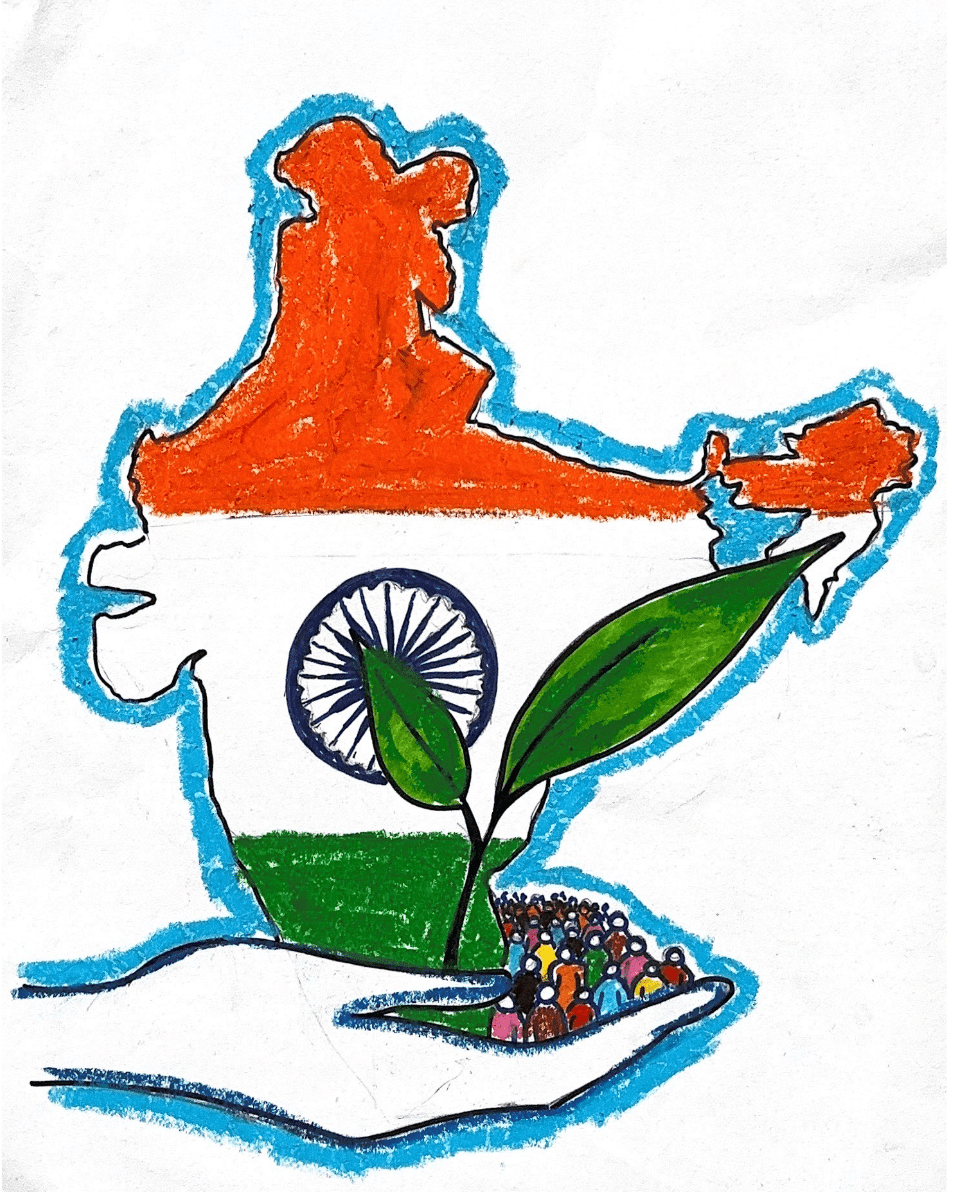
The 21st century has been marked by the creation of several ambitious climate initiatives, like the Paris Agreement and the European Green Deal. While mainly focused on the Global West, the movement for a more sustainable future has spread worldwide, and we are now seeing new laws and agreements regarding sustainability globally. Last year, India’s Ministry of Environment, Forest, and Climate Change introduced their new climate initiative ‘the Green Credit Program’ (GCP) in 2023 shortly after PM Narendra Modi announced a nation-wide effort for sustainability during the COP26 conference in Glasgow (BanQu). India is facing increasing temperatures, climate-related health issues, water levels, food security, and droughts. Climate change is ravaging India, and only worsening their economic and social inequality. This new program addresses the environmental impacts that both individuals and corporations face and gives the Indian people a new incentive to make decisions that will positively impact their environmental footprint. At its most simple, it is a financial incentive for tree-planting. It expands beyond carbon credit proposals, as it acknowledges and includes contributors other than carbon, which gives it incredible potential power. The question is whether it will be effectively introduced and made use of across India.
In a recent press statement, the GCP is described as “an innovative market-based mechanism designed to incentivize voluntary environmental actions across diverse sectors, by various stakeholders like individuals, communities, private sector industries, and companies.” It focuses on afforestation and water conservation but encourages the Indian people to take any level of action; including planting trees, sustainably building and farming, and taking care of the water sources they have access to. One of the ways they are emphasizing the spread of this program across the massive country is through an online platform that simplifies the process of becoming involved and explains exactly how to be eligible for Green Credits: The Green Credit Registry. While the program calls for action by individuals as well as by industries and companies, the latter two are where most of the substantive change will come from. Surprisingly, there is much emphasis on the individual people’s importance in the GCP and appreciated how it looked beyond the industrial ability to make change to stress the significance of lifestyle changes as well. In fact, one of the primary goals is to “encourage environmentally friendly practices”, both on an individual scale as well as a country (Earth.org). Ultimately, the GCP is a governmental initiative that aims to harness the power of the massive population by encouraging and incentivizing eco-friendly behaviors to help reach India’s goal of net-zero by 2070.
The limitations of the GCP are relate to the volatility of the Indian market and its limited reach, including only Indian companies and people. Some experts are also concerned with the environmental robustness of the project, wondering if “market forces can support conservation and sustainability goals” (Simran Sirur) The speed at which the GCP’s introduction across India weakens its overall potential strength; India is diving headfirst into the environmentalist movement, but is this initiative strong enough to withstand market-produced challenges? Or, more importantly, does the market have what it takes to withstand the GCP, and the shock waves it will cause? Trying to transform a massive and crucial economy is not an easy task, and there is widespread concern that the methodology supporting this program will be structurally flawed due to its fast spread and development. On the other hand, the voluntary aspect of the GCP may strengthen it. The incentive-driven aspect is uniquely useful in countries like India where broad enforcement of rules can be difficult, while reliance on positive reinforcement of the behaviors can have a much larger impact than repercussions for harmful behavior. There are possibilities of more regulatory gaps that the initiative fails to address or acknowledge, but those issues will only be revealed in time. Additionally, there is always the concern with these initiatives are reduced to greenwashing and don’t actually have a positive impact. However, the Ministry of Environment, Forest, and Climate Change seems to be aware of that danger and is actively working to make sure it remains an honest, impactful act, it is likely many will see it as an opportunity to take money from the government.
Whether or not this new initiative can make a tangible impact on where India is headed in this crisis is yet to be determined, but it holds considerable potential. The GCP highlights India’s sustainability efforts, which have the potential to really make a positive influence in an area so heavily impacted. India’s new initiative is just one of many being adopted world-wide and shows a global shift towards higher levels of awareness and tangible action to promote sustainability, which is reason to hope for a tree-filled future.




 UnEarth Magazine.
Leave a comment