

Writing by Abigail Myers – Art by Emily Warden
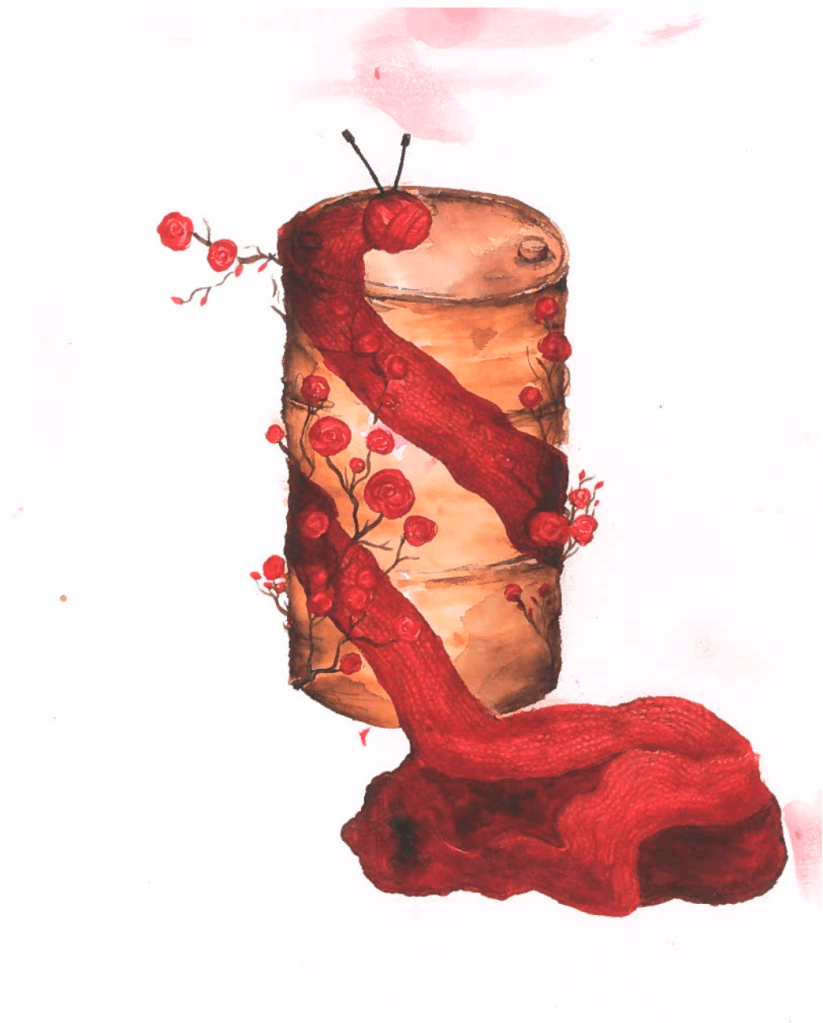
Although there have been significant investments into new renewable energy schemes across the United Kingdom, recently, there have been rollbacks of renewable energy transitions from industry leaders such as Shell and Equinor. Opposition to energy giants may seem daunting, but it is one that a group of ladies called the North Sea Knitters have taken on. Although these ladies may seem unassuming in their older age, they have packed a powerful punch in the environmental activism sphere. they have packed a powerful punch in the environmental activism sphere.
The North Sea Knitters have a clear agenda: to stop the climate warming above 1.5C. They will most likely be working on their signature red scarfs, which serve as a reminder not to cross the 1.5 degrees of warming caused by the rise in global temperature. This warming threshold has been considered a tipping point by policymakers and has been predicted to cause a multitude of climate emergency scenarios. To spread the word about their climate concerns, they can be seen staging ‘knit-in’ where they take to the lobbies of fossil fuel companies. We had the opportunity to engage with members of the organization within and outside of the classroom in Dr. Charlotte Lee’s class at the University of St Andrews called Climate Activism.
Jean, a member of the North Sea Knitters, became an integral person in our class. With her help, we were able to write letters to the Scottish Parliament, sign petitions, and help knit the red scarves. I found myself painting a sign saying, “If you want to stay alive, hold the line at 1.5,” which is what made Dr. Lee’s class effective. We could engage with new activist perspectives outside of those we had previously considered before the class. Jean also explained that their grassroots efforts are effective for their organization because passersby are always curious about the purpose of their ‘knit-in’ and scarves. People are not afraid to talk to these women, and starting a conversation is the first step in reaching a wider audience with their climate goals. In the process, they are also breaking preconceived notions of who can participate in the climate conversations and, thus, what activism is supposed to look like.
The North Sea Knitters have been an outspoken organization against Rosebank, a proposed new oil field in the North Sea, and it has been a divisive topic in Scotland. Equinor was granted permission in 2023 to go ahead with the project but was met with an instantaneous backlash from climate organizations, including the North Sea Knitters. Throughout the class, Jean made it clear that Rosebank was their top priority project to disrupt the ‘business as usual’ mindset for the expansion of oil and gas within Scotland. As of January 30th, 2025, the effects of climate activists were met, with the Rosebank permit being deemed unlawful. This has been a win for environmental groups such as Uplift and Greenpeace, which brought the company to court, as well as the North Sea Knitters, with their continued involvement. However, the motivation for the North Sea Knitters to continue their activist efforts is essential after Keir Starmer, the current British Prime Minister, stated soon after the permits were revoked that he is not standing in the way of Rosebank in the future. The North Sea Knitters have taken this as a direct challenge and have shown increasing momentum in their hunger for change and an energy transition in Scotland and the world as a whole.



 UnEarth Magazine.
Leave a comment