
Writing by Grace Brady – Art by Shaun Nielsen

At the Bottom of the World, in the Middle of the Sea: Marine Protection around Heard and McDonald Islands
Nestled in the remote waters of the south Indian Ocean, Heard and McDonald Islands (HIMI) stand as some of Earth’s least anthropogenically disturbed environments. Unlike other vibrant and biodiverse ecosystems in the Indian Ocean—ranging from Madagascar’s coral reefs to Sri Lanka’s mangrove lagoons—HIMI’s landscape is constantly stark and glacial. These sub-Antarctic islands, situated closer to Antarctica than Australia, are home to an array of animals, including migratory seabird species, penguins, seals, and whales. Despite their isolation, HIMI faces mounting conservation challenges. Pressure from climate change, shifting oceanic conditions, and commercial fishing threaten the biodiversity of HIMI.
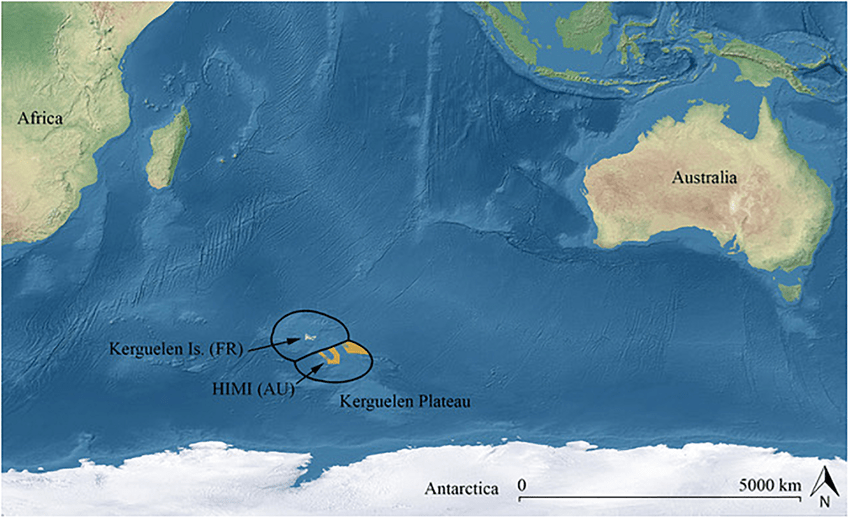
Map from Frontiers in Marine Science
HIMI was first discovered in 1853, with the first landing occurring in 1855. The UK claimed the islands, and by the 19th century, they became a hub for seal hunting, particularly targeting elephant seals. As sealing and whaling industries declined in the 20th century, conservation efforts gained traction. When the islands were ceded to Australia from the UK in 1947, their ecological importance was increasingly recognized.
By 2002, the Australian government designated HIMI as a marine reserve, a critical step in ensuring the long-term preservation of its unique and delicate ecosystem. This reserve is managed by the Australian Antarctic Program under the Environmental Protection and Biodiversity Conservation (EPBC) Act.
A marine reserve is a type of marine protected area (MPA) that restricts human activity to conserve biodiversity. The HIMI Marine Reserve operates under the IUCN conservation framework, where certain areas are designated for strict protection, while others permit limited activities, such as regulated fishing.
The reserve’s management is designed to balance conservation efforts with sustainable resource use. This includes strict regulations on commercial fishing, particularly regarding Patagonian toothfish, a species managed by the Australian Fisheries Management Authority (AFMA) and harvested by Austral Fisheries. However, as global fisheries push further offshore, ensuring that HIMI’s marine life remains protected against overexploitation is paramount.
The expiration of a 10-year management plan, from 2014 to 2024, allowed for the marine reserve boundaries to be renegotiated and expanded. This plan came into effect in January 2025, signaling that work is being done to safeguard this remote archipelago for future generations. Recognizing the growing threats (and U.S. tariffs?!) to HIMI, Australia has proposed an expansion of the marine reserve. The recent plan aims to:
- Increase protections for the marine ecosystem, particularly the seafloor, which is vulnerable to trawling and other fishing practices.
- Strengthen conservation efforts for threatened and migratory species, such as albatrosses and petrels, which rely on these waters for breeding and feeding.
- Establish stricter controls on human activities, ensuring that commercial interests do not outweigh ecological preservation.
- Align with international conservation goals, reinforcing Australia’s commitment to maintaining one of the world’s last truly untouched marine environments.
The proposal has largely received support from conservation groups who argue that an expanded HIMI Marine Reserve would mitigate human and environmental pressures by preserving globally significant biodiversity. By creating undisturbed zones where marine species can thrive, such expansions not only benefit current ecosystems but also safeguard endemic populations for the future.
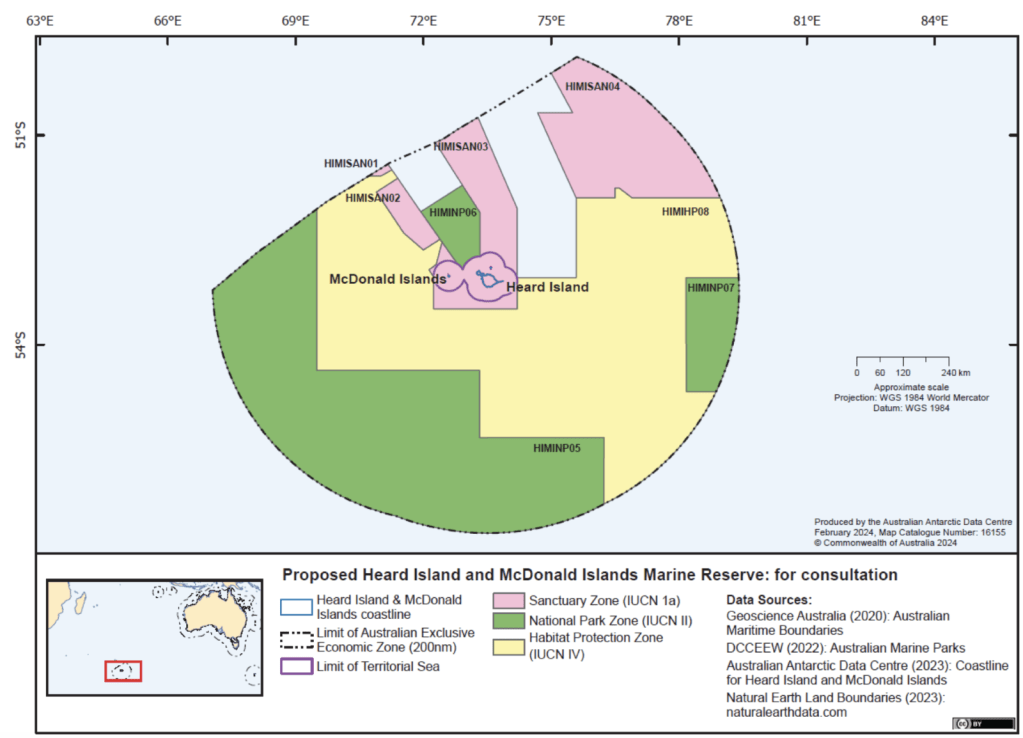
Despite these conservation efforts, challenges remain. Warming ocean temperatures could alter marine food chains, impacting species like krill, a foundational component of the sub-Antarctic marine ecosystem. Additionally, increased commercial interest in the region, for fisheries or potential resource exploitation, raises concerns about enforcement and monitoring. The January 2025 marine reserve expansion also omitted increased protections for underwater ridge ecosystems, so further work is needed to encompass and expand protections around HIMI. The success of the HIMI Marine Reserve depends on rigorous management, international cooperation, and continuous scientific research. Public consultation and ongoing dialogue between stakeholders, including conservationists, fisheries, and policymakers, will be essential in shaping the future of HIMI’s marine conservation.
Significant progress has been made in protecting the sub-Antarctic waters around Heard and McDonald Islands, but the threats of climate change and commercial exploitation necessitate stronger conservation measures. The January 2025 proposal to expand the HIMI Marine Reserve marks a pivotal moment in safeguarding this ecosystem, but it has only been enacted for 3 months. As Australia and the global community push for greater marine protections, HIMI stands as a testament to the delicate balance between conservation and sustainable resource management. This new plan is exciting, but only time will tell if this is a true marine management success story.



 UnEarth Magazine.
Leave a comment