

Writing by Rowan Hunter – Art by Sofia Missana
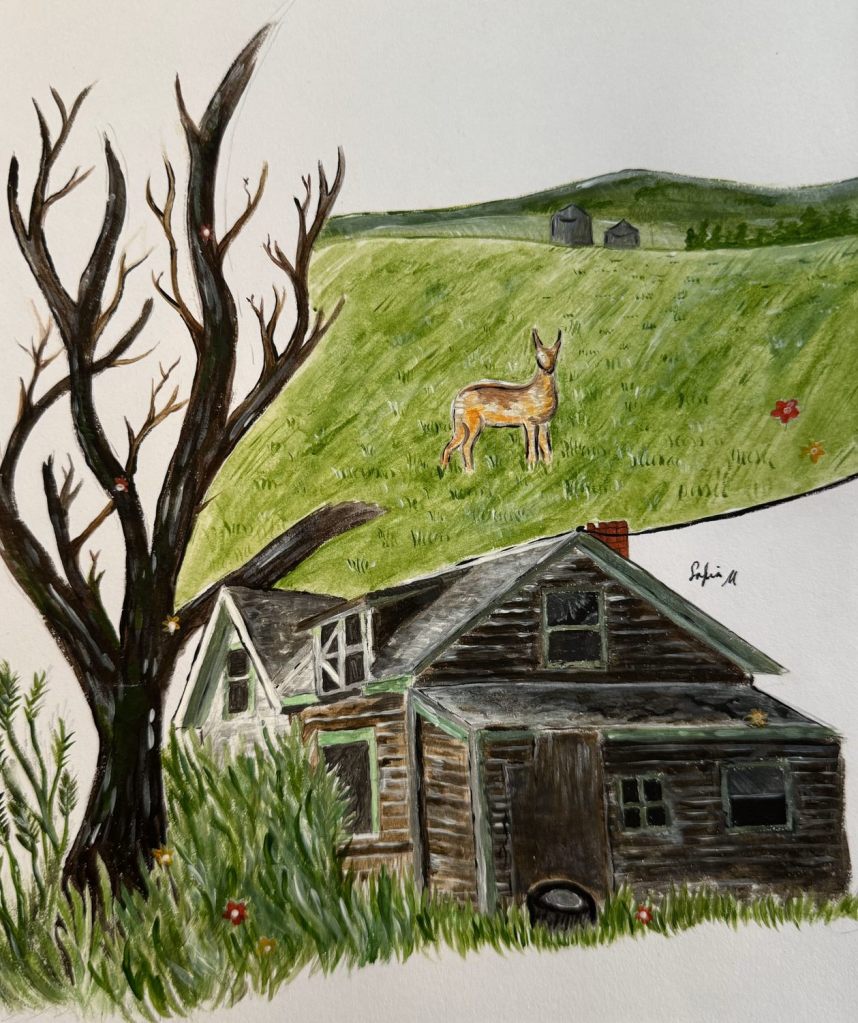
We’re driving down an unpaved range road, the Tragically Hip playing through the car’s tinny speakers, my mom complaining at every pothole because it’s a rental and the gravel’s dinging it up. They say you can never really go home, and I’d say it rings true, but that’s not quite the point of this story. The road is one I once knew very well but haven’t travelled in years, and it strikes me with an uncanny mix of familiarity and foreignness, like pictures of your parents as kids. Everything I see is blue and gold. This is summer in Alberta: the sky still and cloudless, the wheat fields rippling like a lake in the warm breeze, the road prodigiously dusty. Just ahead, a deer startles out of the ditch, away from the road into a seemingly endless field. I am eighteen years old and feel as though I’m driving backwards through time.
The barn’s fallen in—that’s new since last time we were here. Far and away up the hill, past rusty barbed wire and crooked fenceposts, framing juts out to the right like a half-exposed ribcage. The old shack, too, the one that’s been here since 1901, is slowly sinking into itself as weeds grow up the sides. We can’t tell if the chokecherry tree is dead or not. My mom and I wander the place slowly, thirty degrees of late June thickening the day to syrup. I’m struck by the quiet—not silence, but quiet. The landscape seems to shimmer and hum with heat, cicadas and crickets a constant drone, occasionally punctuated with red-winged blackbirds’ songs. It feels like nothing might have moved here in years.
We start in the old garden—well, close to it. The entrance, that gap in the hedge, is long overgrown with tall grass, probably much like what grew here before my great-grandparents. The Earth remembers, and so do we; I remember soft, warm garden soil, and carrots eaten straight from the ground, and hiding under giant rhubarb leaves that filtered the sun and set the world a-glowing green. The lilacs around the house are flowering, and they smell as good as ever. The ones on the side of the abandoned house, too. I’m honestly surprised it’s still standing. It’s been empty longer than I’ve been alive, and way back when we lived in this farm’s other house, walking past it at night used to scare me half to death. It’s decrepit but pretty, really, gabled and trimmed green and among trees – just a place where family used to live.
I think kids are afraid of things ending; I think growing up is getting friendly with ghosts.
I let the deepening afternoon wash over me.
From the corner of my eye, I see myself as a child, passing through the yard. I pretend not to see her; she clambers up the good climbing tree with a book in one back pocket and a box of saltines in the other. After a while, she comes down, sticky from sap, with scrapes on her knees and pine needles in her hair. Quick as a flash she’s past me, and I chase her; down to the end of the driveway, down the black dirt road, past the old farm equipment and falling-down grain sheds. Neither of us have ever really liked running, so we stop pretending and just walk together to the edge of the field. Everything is dark earth and growing grain, the feeling of the living wheat brushing against sun-warmed skin as we move through it like water. Arms outstretched, I start to spin, this dance I’ve done so many times. I am five and seven and twelve and fifteen again all at once, and I imagine that I feel the stalks at my palms and shoulderblades like they used to be, and that I can reach out and find her there, dancing with me.
When I stop, dizzy and electric with joy, I’m just me, standing in an empty field with wheat up to my waist. I turn my face to the sun like a plant, and find that the sky is just as big as ever.
[Songs of the story, listen here ]



 UnEarth Magazine.
Leave a comment