

Writing by Isabella Saunders-Cook – Art by Defne Celiktemur
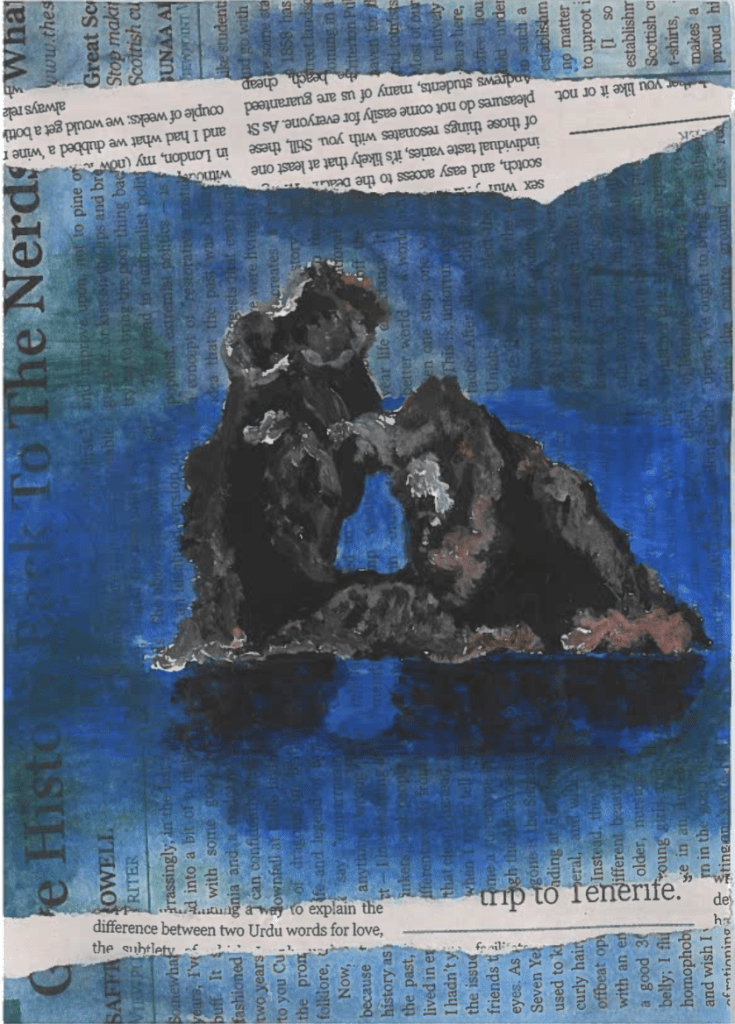
The mainstream media (and increasingly social media) has a monopoly over public perception of sustainability issues and global progression towards their resolution. Therefore, the power of the article is very strong.
When reading any article or watching any news report, the title is the first thing we look at, the biggest writing on the page, and what we are most likely to remember. Yet, titles are frequently the least accurate component of media coverage, as they are typically used by outlets as means to increase readership and – as such – revenue. This means they are often exaggerated or are simply removed from the context in which they can be more accurately understood.
This has often been the case within media coverage of El Hierro’s renewable energy projects.
El Hierro – the smallest of the seven Canary Islands, with a population of just 10,000 – is renowned for its fast and furious renewable energy development. After five years of construction, the island inaugurated its ‘Wind-Pumped Hydro Power Station’ in 2014, as part of an overarching goal to satisfy 100% of its energy demand from renewable resources.
On average, just over half of annual energy consumption on El Hierro is now powered by wind and water, and plans for a new photovoltaic plant are now in place to continue progress towards the 100% renewable energy goal. Perhaps even more impressively, the island has already managed to power itself for 28 consecutive days using only renewable energy, beating its own 2019 world record of 24 days in the process. The successes of the project also extend far beyond progress towards energy sustainability. The Wind-Pumped Hydro Power Station’s construction took a multi-level governance approach to ensure that local residents were represented in the development process. In the words of Jose Etcheverry of Toronto’s York University, “Nobody compares to El Hierro.”
While achieving permanent 100% energy sustainability is still a work in progress, renewable energy development on El Hierro nonetheless serves as a beacon of hope for international efforts towards the achievement of energy sustainability. Such success stories are crucial to our resilience, determination, and productivity as we tackle anthropogenic planetary challenges. We must take small wins where we can, celebrate progress, and learn from those places and communities who are on the right track.
It is important, however, that we have an accurate idea of El Hierro’s renewable energy progression if we are to use it as credible inspiration for the ‘green transition’. This may be challenged by misleading media coverage of El Hierro’s renewable energy successes, particularly where titles are concerned. Articles discussing El Hierro’s renewable energy projects are often headlined with inferences that the island already uses 100% renewable energy. While most then go on to admit that this remains a goal and is not yet a reality, some are more ambiguous. As readers, we must be wary of this, especially if we are depending on an article for important information or are planning to act on what we learn.
We need success stories like that of El Hierro. They fill us with hope by bridging the gap between the struggles we face and our ultimate ability to minimise them. They remind us that reaching a sustainable world is not as out of reach as we might think – that where there is a will, there is a way.
However, we readers must be vigilant. If we are to take such stories as inspiration, we should aim to understand their full narrative. This means we must read beyond titles, focus on the facts, and source our information widely. Doing so confirms that even on El Hierro, achieving 100% renewable energy usage on a permanent basis is still a work in progress. While we can take substantial hope from El Hierro’s story, we must not discard the long road ahead towards energy sustainability.




 UnEarth Magazine.
Leave a comment