

Writing by Lydia Allan – Art by Julia St John
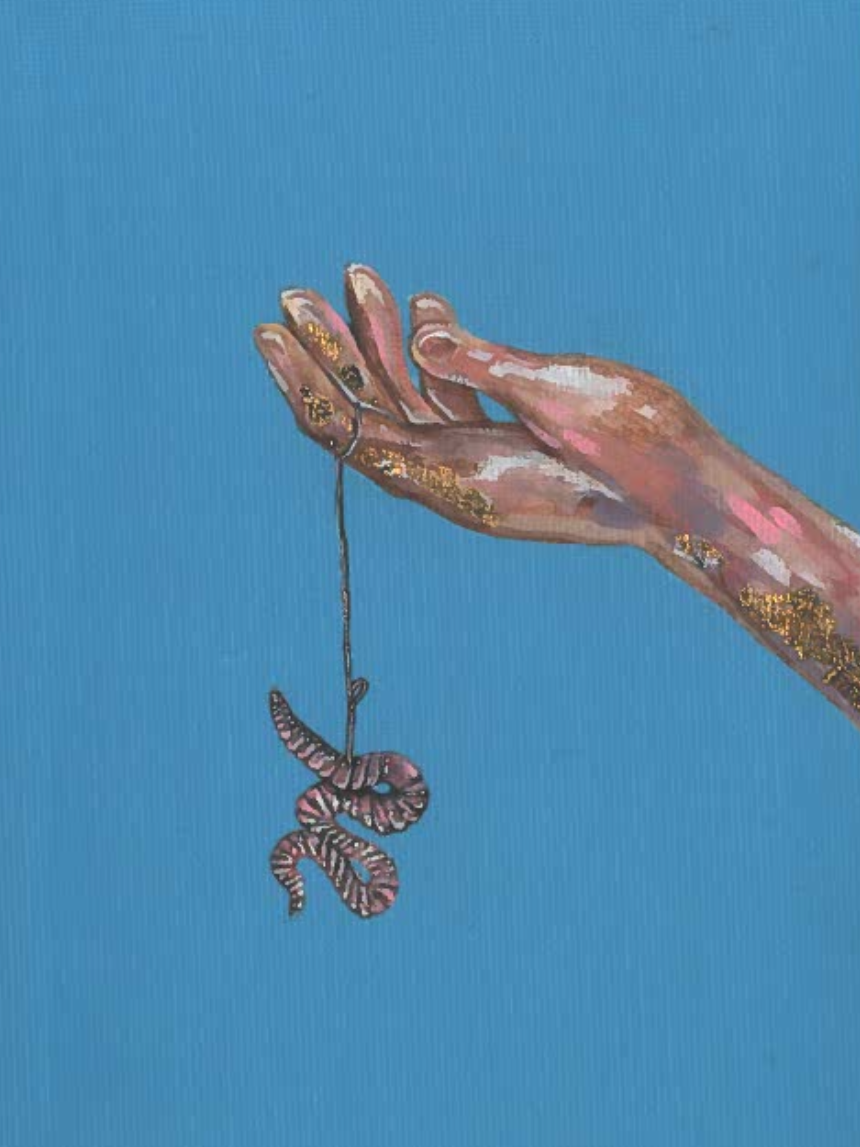
A plea for conservation without aestheticisation, and consumption valuing sentience
I write this piece beyond frustrated with the clear inconsistencies in how humans attribute value across nonhuman lifeforms. Why do aesthetics play such a prominent role in how conservation practices are supported and unfold, while the sentience of individual beings is ignored when it comes to human consumption?
We are in a state of ecological crisis. Global biodiversity is declining at a catastrophic rate, and our wildlife populations have depleted by almost 75% in the last 55 years. Urgency is required in our conservation efforts, yet a key question remains: how do we decide which organisms survive and which are left to perish? I believe our current approach focuses wrongly on the aestheticisation of certain flagship species – gorillas, tigers, pandas – neglecting their intrinsic value and that of others lesser-known. To be clear, I am not arguing against their conservation – they are more than deserving of our attention and protection. I additionally acknowledge how the visual appeal of certain species may garner public support towards conservation efforts more generally. What I do not agree with, however, is the favouritism these species are then offered, particularly given the undermining of the ecosystem-wide importance of many other organisms.
I am drawn to thinking about the ethical dilemma of invasive species, where allowing one species to proliferate will come at the expense of another. Speaking to activist Gary Francione, he argued that we should never have allowed ourselves to reach a state where we must prioritise one lifeform over another in conservation practices. From a sentientism angle this holds true, but there is no point arguing for a hierarchy-free valuation in locations where invasive species are damaging entire ecosystems. I suggest shifting the balance from heart to head in decision-making by focusing on species’ contribution to functioning of the wider ecosystem. It is still highly unfair to have to be selective, yes, but being selective in a way that strives to maximise survival as an endpoint seems like the most ethical way forward. We need to protect the greatest number of species and lives possible, not just those with promotional value.
A different avenue where I would deem it essential to prioritise individual sentience is in our food and farming systems. I find it somewhat hypocritical that people shun those partaking in trophy hunting of elephants, rhinos, and lions, yet continue to indirectly support the annual loss of around 100 billion animals through factory farming. That is not to say that I support or condone trophy hunting – quite the opposite – but I ask why it is inhumane to unnecessarily take the life of an animal in one context and not another? What I believe fuels this discrepancy is a cognitive dissonance made between populations and the food they eat. It is easy to pretend that pre-packaged supermarket meat was not once a living, breathing individual, or that male chicks were never culled to improve the efficiency of supermarket egg production. In contemporary conservation practices it is often necessary to pick a side merely to prevent ecological collapse, but there really is no excuse when it comes to consumption of animal products.
Issues therefore lie not just with aestheticisation, but also a human-centred approach to sentience and intelligence which, at its worst, inflicts pain or death upon species we deem unworthy of protection. People who consume fish based upon assumptions that they are less intelligent fail to acknowledge that they can indeed feel pain, fear and distress, and have been observed to change their behaviour accordingly. Yes, their expression of these feelings is not anthropomorphic, but why does this invalidate them? As individuals, one of the easiest ways to conserve life is to be more mindful of our own consumption practices. Shifting away from the use of animal products will gradually influence supply and demand, minimising the loss of farmed animal life in a way that deems their lives of equal importance to ours. There should be no hierarchy of consumption outside of natural predator-prey relationships; nothing about contemporary factory farming is natural, and humans can survive perfectly well on a diet which inflicts minimal harm on other sentient life.
I reach my word count feeling as though I have just gotten started. Clearly this is too complex of a debate to confine into one article. I hope it has nevertheless been made clear that an adaptable, holistic valuation system is urgently needed. Finally, if there is one overarching connection between my opinions on valuation within conservation and food systems, it is that humans must be decentred.


 UnEarth Magazine.
Leave a comment