
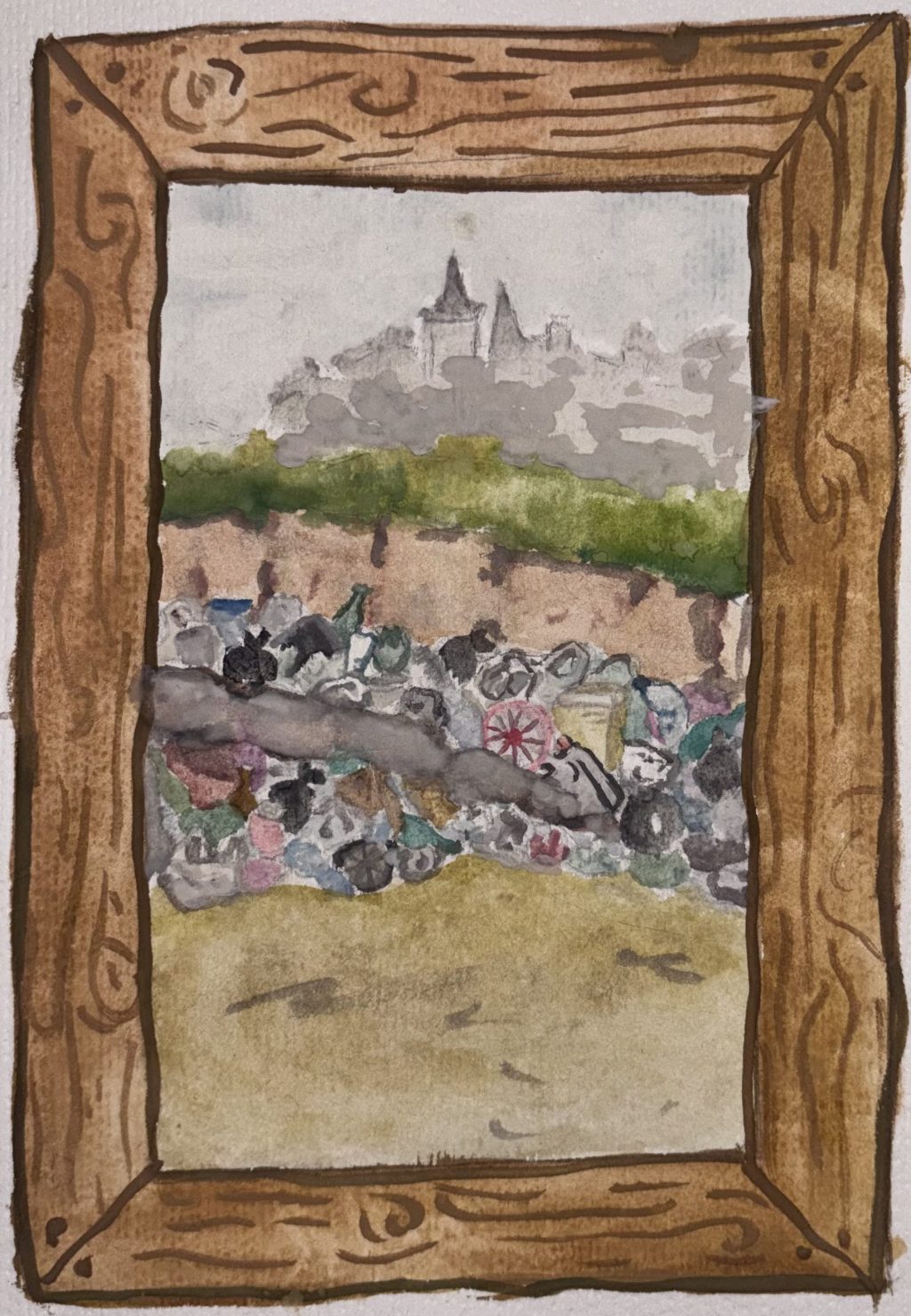
Words by Amy Hargreaves, art by Ru Todd

Every week, the tide brings more
On a bright morning, West Sands can look untouched. Spend an hour bent over the strandline, though, and the picture changes.
Every week, the St. Andrews Marine Society runs a beach clean on the town’s beaches, and one stands out: Aquarium Sands. In the second semester of last year, there were weeks when we collected 16 kg of rubbish from that one small beach, and others when we collected 10 kg. Most of it is small: plastic fragments, bottle caps, crisp packets, cotton-bud sticks, and tangles of rope and fishing line caught in the seaweed.
What strikes me most is that it keeps coming back. A stretch we clear one week is littered again by the next, meaning those totals are not a backlog built up over years, but rather a measure of what washes ashore in just a few days. Some of it is clearly dropped by people using the beach. Much of it, judging by its wear and the barnacles growing on it, has travelled a long way to get here.
That is why beach cleans interest me beyond simply keeping the beach clean. They show where our waste ends up, and how close everyday life is to the sea.
A national problem on a local beach
What we find in St. Andrews is part of a much bigger pattern. In 2025, Marine Conservation Society volunteers removed 385,551 pieces of litter from Scottish beaches. That works out at 157 items for every 100 metres surveyed. Across the UK and Channel Islands, 87% of recorded items was plastic.
Plastic is the hardest part to deal with because it never really disappears. Large items simply break into smaller pieces, which are harder to pick up and easy for seabirds, fish, and seals to swallow.
Not all of it starts at the beach. Litter washes down drains, burns, and rivers before it reaches the coast, so protecting the sea does not begin at the water’s edge.
Lost or discarded fishing gear is another significant source of marine pollution. In St. Andrews, we find rope, net fragments, fishing line, and other equipment along the shore. Line and rope pose a particular threat to wildlife, because animals become entangled in them.
Why we count what we collect
Through the Marine Conservation Society’s Beachwatch programme, volunteers record every item they find on a 100-metre stretch of beach, turning a clean-up into citizen science. Over more than 30 years, that data has helped win changes such as the plastic bag charge and the ban on plastic-stemmed cotton buds.
So far, beach cleans in St. Andrews have focused on removing litter rather than recording it, and we have not yet submitted any Beachwatch surveys. It is something I would like us to start. Weeks like our 16 kg haul at Aquarium Sands would be far more useful if every item were logged, adding our coastline to the national record and helping trace where the litter comes from.
There are signs that surveying yields meaningful results. In Scotland, litter fell from 204 items per 100 metres in 2024 to 157 per metre in 2025.
That does not mean the problem is solved. Hundreds of thousands of items are still being pulled off Scottish beaches each year, and a stretch that looks clean one week can look very different after the next storm.
What the beach is telling us
Running these cleans has made marine pollution feel far less abstract to me. Reading about a global problem is one thing. Picking it out of seaweed on a beach you walk along every week is something else.
Beach cleans alone will not solve marine pollution, however. Stopping waste at its source matters far more than removing it afterwards. But cleans protect wildlife, produce useful data, and make a hidden problem impossible to ignore.
The litter on the St. Andrews coast is a tiny part of a global problem. Every piece still tells us something about how we use, discard, and value the things around us. Perhaps the clearest lesson from our beaches is that what we throw away rarely goes away.
Join us on the beach
The St. Andrews Marine Society runs a beach clean every week. No experience is needed, just bring warm clothes and an hour of your time. Follow @standrewsmarinesociety on Instagram for updates.
Sources
- Marine Conservation Society, Beachwatch 2025: What you found
- Marine Conservation Society, Great British Beach Clean 2025: The results



Leave a Reply