
Words by Jennifer Greene, art by Eliza Thorpe
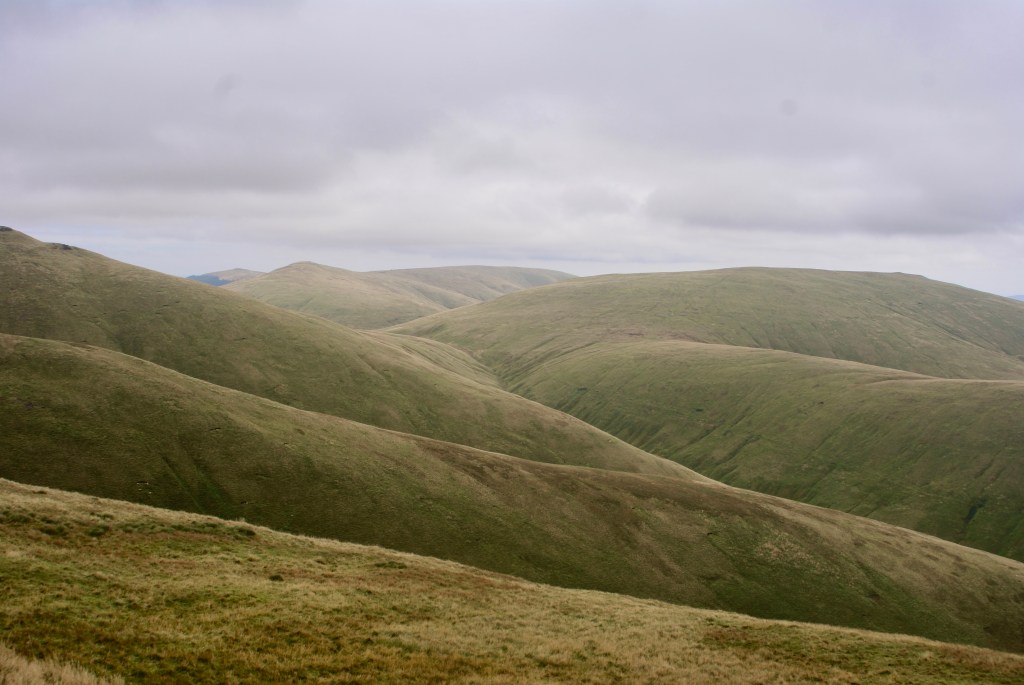
Not far from here, you can find two hills resting against the sky, usually seething with increate rain which lingers over central Fife. The Lomond Hills are sleeping bodies under the pale wheel of wind, and they ache with heather along their sides. The hills are neither passive nor provocative, and similarly to the human body, the hills exist for themselves and not for the eye of the viewer. Each dome and rocky spike is a limb of its own. Their forests act like lungs that clean and charm the air around them. But despite their innocence, the local conception of these hills relates to the female anatomy, because the hills are known locally as the Breasts of Fife, or the Paps of Fife. Unfortunately, this nickname is not uncommon within Scotland.
I learned about these hills in second year while I was re-reading Nan Shepherd’s The Living Mountain, reminding myself of how nature is often feminised and sexualised. In wider literature and academia, patriarchal interpretations of wildlife equate both woman and nature as subordinate to man. Fields are to be ploughed and penetrated, and explorers thrust themselves into forests. Summits are domains for competitive conquering and virgin territories are sought out for possession. Flowers are to be plucked from their beds so their beauty can make a profit. The language used to describe landscapes aligns with patriarchal inclinations of domination, appropriation and sexualisation. This idea of women and nature as passive entities completely undermines women’s agency and nature’s intrinsic value. It is the production and reproduction of restrictive binaries like human/ nature and man/ woman that disrupt our connection to nature and each other. Neal Alexander at Aberystwyth University encapsulates this perfectly: landscape is often written in a way that adheres to “possession and mastery rather than sensuous involvement”.
This negative characterisation of nature is especially relevant to the Scottish Highlands and the traumatic legacy of the Highland clearances. Areas in Scotland are still scarcely populated because of historic loss, forced eviction, emigration and exile. This lends to a sinister romanticising of the landscapes’ “emptiness”. These vast, empty, “new lands” also host mountains that were described as “monstrous creatures of God” by the English poet Thomas Gray, when he visited during the Highland clearances. This expunges local memory by demonising the landscape which has been ecologically depleted and depopulated. Such language completely obscures Scotland’s turbulent history, and constructs a monstrosity of its natural beauty.
Ecofeminist theories denounce violence against women and nature, and offer solutions for a more immersive connectedness to nature. Ecofeminist writing is also concerned with reclaiming the woman’s body because the woman’s body has been robbed, appropriated and sexualised so often through patriarchal rule. Nan Shepherd conveys a sensual, erotic, queer connection to the Scottish highlands through the body and the senses. She writes in The Living Mountain that “the hands have an infinity of pleasure in them”, and “one is not bodiless, but essential body”, creating a sensual momentum in her self-immersive nature writing (Shepherd, 1977). Nan Shepherd often used to sleep outside in the mountains and heather, allowing herself to “walk the flesh transparent”, as she felt her body would merge with the mountain (Shepherd, 1977). To write about her own physical and spiritual connectedness to nature, she subverted patriarchal forms of writing by emphasizing the somatic experience in literature, relating woman’s sensation and desire to nature in a way that undermines conventional masculine writing.
This reminded me of Hélène Cixous, a French writer who explored feminist embodied resistance in her essay The Laugh of the Medusa. I found this essay in my second year at St Andrews and feel that it aligns well with depictions of a sensual connection to nature. In her essay, she describes how women’s bodies and the art of writing are grounds for embodied resistance and a sensual interpretation of the world. She speaks of the importance of somatic expression; “censor the body and you censor breath and speech at the same time”, and defines the unconscious as a “limitless country”. She urges women to “inscribe the breath of the whole woman”, for “her flesh speaks true. She lays herself bare.” This abstract conception of the sensual female body overlaps with Nan Shepherd’s assertion that nature is something to be felt and experienced through the hands and heart. This contradicts and dismantles the patriarchal conception of nature as something separate from humanity.
The Scottish landscape has been vilified by intersecting misogynistic and “monstrous” characterisations of its features, where Nan Shepherd’s ecofeminist approach and Hélène Ciixous’ emphasis on the reclamation of the female body offer a refreshing antidote. The bigger picture drawn from the local example of the Paps of Fife can be used to promote a more ethical representation of the non-human world in the context of Fife and Scotland.
Picture credits; https://www.ladyscience.com/features/reframing-mother-nature-misogynistic-climate-denialism



Leave a Reply