Words by Mae McGinely Smith, art by Siobhan Henderson
Salmon farming has become one of Scotland’s most valuable food industries, supporting jobs in rural communities. But the familiar pink fillet hides a more complicated truth, as salmon are raised in open-net pens swimming with sea lice, disease and chemical treatments. This affects both farmed fish and the wider environment. As production continues to expand, Scotland is faced with a central question: do the benefits outweigh the cost?
“We only get what the lice don’t eat.”
A man, resplendent in bow tie and boater, is setting up his picnic on the side of an idyllic loch. He is surrounded by lush greenery, the sun is shining and the food looks delicious. However, there is one exception. The salmon. It’s grey and crawling with sea lice. The man dyes the flesh pink, liberally dousing it with both hydrogen peroxide and formaldehyde in order to create what he describes as ‘premium’ salmon. This short film, fronted by the BBC ‘Springwatch’ presenter and environmentalist Chris Packham, is part of Project Slingshot’s new campaign against Scottish salmon farming. They claim that, “Fish [are] swimming in a toxic soup of flesh-eating parasites and chemicals.”.
Project Slingshot aims to “strip factory farming of its social licence, so that the whole system, rather than any one practice, becomes culturally and politically indefensible.”. They have previously been in the news for their advertising drives against factory farmed ‘frankenchickens’ and the CO2 gas chambers used in pig slaughter. Now, over 5,000 advertisements across the London Underground are targeting supermarkets like M&S in an attempt to stop the sale of factory farmed salmon.
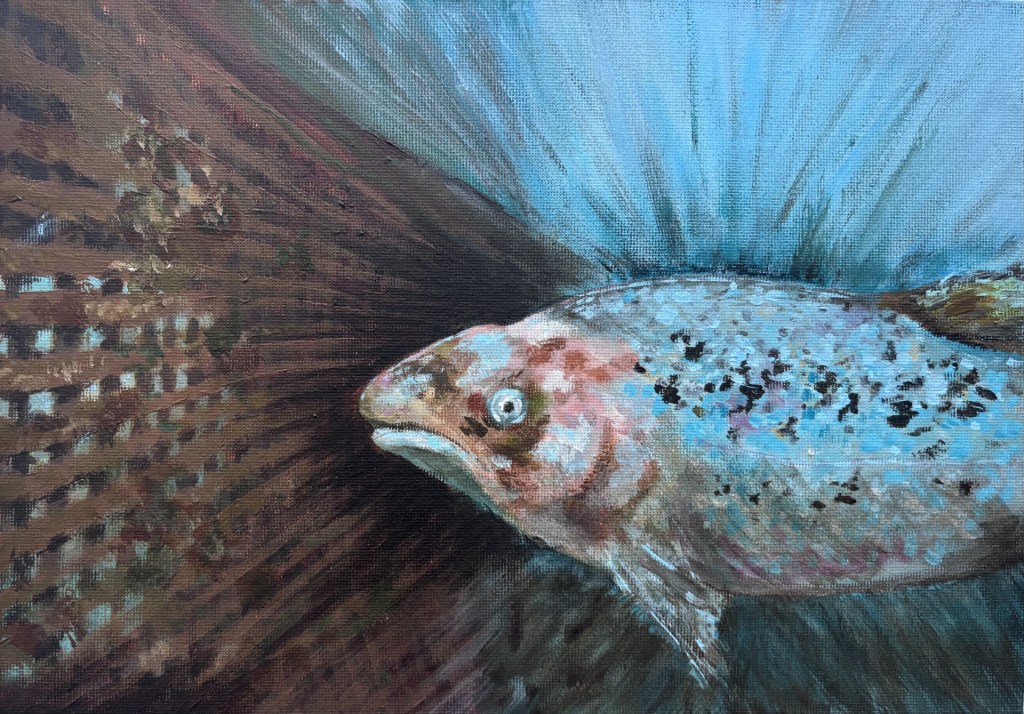
The face of this project, Chris Packham, told The Telegraph that “confining [salmon] in sea cages exposes them to excessive levels of parasites, a range of diseases and practices that cause extreme suffering.” Between November and December 2025, a video made by Animal Equality showed salmon cages infested with sea lice. These parasites feed on the skin and blood of fish, and salmon can be seen struggling with open wounds, fungal infections and missing faces.
Salmon Scotland represents the companies involved in Scottish salmon farming, stating on their website that, ““Environmental stewardship sits at the heart of Scottish salmon farming.”. Salmon Scotland maintains that their farmers, “monitor sea lice closely and take action to keep levels low,” and “use a wide range of measures to protect fish health and welfare, including careful monitoring, good nutrition, vaccination, environmental management, and treatment when needed,”. A spokesperson has been quoted previously as saying that, “Claims made by activists are often taken out of context and present a misleading picture of what is happening on farms, […] Farms operate to world-leading welfare standards, backed by strict regulation, veterinary oversight, regular audits, and inspections.”
M&S responded similarly to claims of mistreatment, with a spokesperson explaining, “M&S salmon is farmed responsibly to the highest welfare standards, supporting an industry that offers thousands of UK jobs. M&S farms uphold the highest standards of welfare – exceptionally low stock density with just 1.5pc fish to 98.5pc water, continuous water quality monitoring, high-quality feed and vet care.”
Salmon generates 760 million pounds for the local economy, and is the UK’s largest food export. The Scottish Government’s 2025 Scottish Fish Farm Production Survey found that nine companies, with 210 operational sites between them, play an active role in Atlantic salmon production. These sites employ over 2,460 people and salmon production has increased by 3% from 2024 to 2025.
While the survival rates of salmon have increased in recent years, 15 million animals in 2025 never made it to harvest (equivalent to a third of all salmon). Between 2023 and 2025, there were a total of 35,867,788 salmon deaths. An Animal Equality UK freedom of information request found that since 2022 the Animal and Plant Health Agency (APHA) received 22 complaints of fish welfare abuses. Mowi, the largest salmon farming company in Scotland, had two incidents within a month: 100,000 fish first suffocated as a result of worker neglect, and more than a million fish were later killed by a hydrogen sulphide buildup. Bakkafrost, another salmon farming company, had two incidents in 2022 where over 2 million fish were killed by similar hydrogen sulphide buildups. The APHA undertook enforcement in the form of verbal or written advice, and conducted follow-up visits as opposed to formal warnings, care notices or referral to the Crown Office and Procurator Fiscal Service.
Salmon farming companies have been found discharging formaldehyde into lochs, with over 48,000kg released into fresh water across Scotland in 2025. Formaldehyde has been shown to have long-term cancer risks and cause damage to the skin, respiratory system and eyes. Azamethiphos and deltamethrin are insecticides used in salmon farming that can disperse into aquatic environments and are toxic to other types of marine life. The production of each tonne of salmon creates the same amount of waste as 80 humans and is released directly into the environment. Expansions in Shetland and Loch Long were projected to produce sewage outputs that would be, respectively, 20 times the Shetland population and more than the Edinburgh population.
Salmon farming in Scotland is simultaneously a major economic asset and a source of ongoing environmental and welfare concerns. The industry supports jobs and contributes substantially to Scotland’s food exports, but high mortality, sea lice, chemical discharge and waste are testing claims of sustainability. The current gap between the industry’s polished, greenwashed image and the reality of open-net pens is becoming difficult to ignore. Until these issues are addressed with greater transparency, it may be time to reconsider if farmed salmon belongs on our plates.


Leave a Reply